
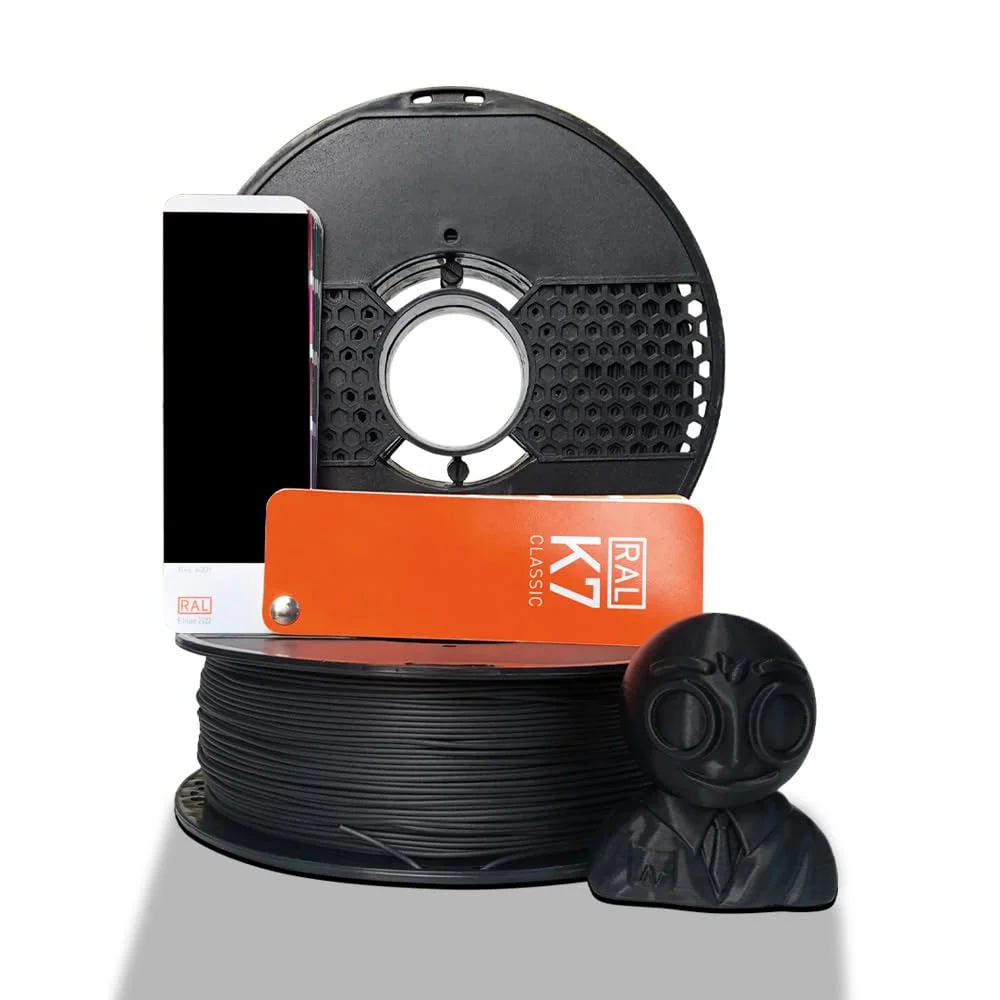

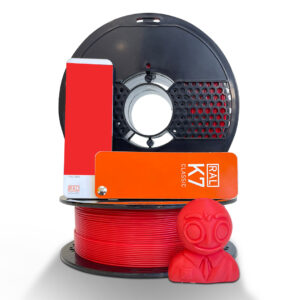
TPU Raven Black by NFIL3D is a flexible 3D printer filament designed for applications that require bending, elasticity, wear resistance and impact absorption. Manufactured from thermoplastic polyurethane (TPU), this filament is an option for creating flexible phone cases, protective covers, grips, bumpers, gaskets, wearable prototypes and custom functional accessories.
Unlike rigid printing materials such as PLA, TPU can deform under suitable loads and return toward its original shape, depending on its formulation, hardness and printed-part design.
NFIL3D TPU Raven Black 1.75mm features a deep black colour, nominal 1.75mm diameter and manufacturer-stated 1kg net filament weight. The supplied product description also specifies an advertised ±0.015mm filament diameter tolerance.
Its flexible properties make it suitable for makers, product designers, engineers and hobbyists who want to explore applications that are difficult to produce using ordinary rigid filament.
Why Choose TPU Raven Black?
TPU Raven Black combines the flexibility of thermoplastic polyurethane with the versatility of FDM 3D printing.
Flexible filament can be useful for components that must bend, cushion impacts, provide grip or accommodate movement.
When correctly selected and printed, TPU can be used for protective accessories, vibration-damping components and flexible prototype parts.
The Raven Black colour offers a neutral finish suitable for practical designs, customized accessories and product prototypes.
Unlike rigid PLA, TPU can produce parts with a rubber-like feel. However, its exact softness depends on the Shore hardness grade, which has not been provided for this specific product.
For applications requiring a particular level of flexibility, confirm the material’s Shore hardness and mechanical properties before final production.
Key Features and Benefits of TPU Raven Black
1. Flexible and Elastic TPU Material
TPU Raven Black is based on thermoplastic polyurethane, a flexible polymer used in a variety of 3D printing applications.
TPU can bend and deform without immediately breaking when used within suitable operating conditions.
This behaviour makes it useful for flexible accessories, protective covers and selected functional components.
The amount of flexibility depends on the material’s Shore hardness, wall thickness, infill density and model geometry.
A thin TPU part may feel very flexible, while the same material printed as a thick solid structure can be considerably stiffer.
For projects requiring specific compression or recovery characteristics, finished-part testing is recommended.
2. Deep Raven Black Colour
The Raven Black colour provides a clean, dark appearance for printed models.
TPU Raven Black is suitable for protective cases, black grips, customized bumpers, flexible accessories and prototype components.
The final surface finish depends on layer height, printing temperature, extrusion quality and model geometry.
A consistent outer-wall speed and suitable material flow can help create a more uniform appearance.
For colour-sensitive production, compare actual printed samples.
3. Impact Absorption and Protective Applications
TPU’s flexible material characteristics make it useful for parts intended to cushion routine contact or absorb limited mechanical impacts.
TPU Raven Black may be used for protective bumpers, equipment feet, edge guards and non-critical shock-absorbing accessories.
However, its exact impact performance depends on the material formulation and printed-part design.
The product should not be described as having a guaranteed impact rating without verified technical test data.
For protective equipment or safety-critical applications, material selection and finished-part testing are essential.
4. Abrasion and Wear Resistance
TPU materials are commonly selected for applications where repeated handling and surface contact occur.
TPU Raven Black can be considered for grips, flexible feet, protective sleeves and suitable mechanical accessories.
Actual resistance to abrasion depends on the TPU grade, contact surface, applied load and operating environment.
Printed-part durability also depends on print orientation and interlayer bonding.
For moving parts exposed to continuous friction, evaluate the actual service requirements before using the material.
5. Nominal 1.75mm Filament Diameter
TPU Raven Black features a nominal filament diameter of 1.75mm.
NFIL3D’s supplied description advertises a diameter tolerance of ±0.015mm.
Controlled filament diameter is important because the slicer calculates extrusion flow using the configured filament size.
However, the ±0.015mm figure refers to filament diameter tolerance, not guaranteed dimensional accuracy of finished printed components.
The accuracy of a printed part depends on printer calibration, extrusion flow, geometry and TPU’s flexible behaviour.
6. Good Layer Bonding with Suitable Settings
TPU is known for its ability to form strong bonds between printed layers under appropriate extrusion conditions.
TPU Raven Black may be suitable for flexible parts that experience bending and handling.
Layer bonding depends on nozzle temperature, cooling, printing speed and material condition.
Excessive cooling, unsuitable temperatures or poor extrusion can reduce finished-part performance.
For demanding applications, inspect and test completed prints.
7. Designed for Compatible Flexible-Filament Printers
TPU Raven Black is intended for FDM and FFF printers capable of handling 1.75mm flexible filament.
A direct-drive extruder with a constrained filament path can make flexible materials easier to feed.
Some Bowden systems may also print suitable TPU grades, although they may require additional tuning.
The material should not be described as universally compatible with every 1.75mm printer.
Printer compatibility depends on the extruder, filament hardness, hotend and slicer configuration.
8. Moisture-Conscious Storage
TPU can absorb moisture from the surrounding environment.
Excess moisture may contribute to bubbles, stringing, rough surfaces and inconsistent extrusion.
For reliable results, TPU Raven Black should be stored in a dry, sealed container or protective bag with suitable desiccant.
If moisture-related defects appear, use a drying procedure appropriate for the exact TPU formulation and spool.
Do not assume that a newly opened package or an unused spool is permanently moisture-free.
9. Full 1kg Net Filament Weight
The supplied NFIL3D product description specifies 1000g (1kg) net weight of usable TPU filament.
This weight excludes the empty spool and outer packaging.
A 1kg spool can support multiple small printing projects or larger flexible models.
Actual material consumption depends on model dimensions, wall thickness, infill, supports and printer settings.
10. Suitable for Custom Functional Designs
TPU Raven Black provides design flexibility for projects where rigid materials may not be appropriate.
Makers can create custom shapes, flexible contact surfaces, protective accessories and experimental mechanical parts.
The final performance depends on the component’s geometry, infill structure, print orientation and material properties.
Applications of TPU Raven Black
Flexible Phone Cases
TPU Raven Black can be used to prototype customized flexible phone cases and protective covers.
A suitable case design should consider thickness, fit, button access and the required protection level.
Grips and Handles
Print ergonomic grips, handle sleeves and customized contact surfaces.
TPU’s flexibility can provide a softer feel than rigid printing materials.
Gaskets and Seals
TPU Raven Black can be used for prototype gaskets, flexible spacers and sealing concepts.
However, printed TPU is not automatically watertight or pressure-rated. Sealing performance requires appropriate testing.
Bumpers and Protective Feet
Create non-critical protective bumpers, equipment feet, vibration-damping pads and edge guards.
Wearable Accessories
TPU Raven Black may be used for flexible wearable prototypes, costume accessories and customized bands.
Skin-contact suitability should not be assumed without appropriate material verification.
Footwear Prototypes
Design experimental shoe inserts, flexible sole concepts and footwear accessories.
Comfort, durability and load performance depend on the specific TPU grade and printed geometry.
Robotics and Mechanical Prototypes
TPU Raven Black can be used for flexible joints, protective covers, compliant mechanisms and selected vibration-damping components.
Educational and Engineering Projects
Print flexible design demonstrations, material comparison samples and prototype components for learning and product development.
TPU Raven Black Technical Specifications
| Parameter | Specification |
|---|---|
| Product Name | NFIL3D TPU Raven Black 1.75mm |
| Brand | NFIL3D |
| Material | TPU |
| Full Form | Thermoplastic Polyurethane |
| Colour | Raven Black |
| Nominal Diameter | 1.75mm |
| Advertised Diameter Tolerance | ±0.015mm |
| Advertised Net Filament Weight | 1kg |
| Spool Weight | 250g, per supplied description |
| Total Weight with Packaging | Approximately 1.6kg, per supplied description |
| Material Characteristic | Flexible and elastic |
| Shore Hardness | Not specified; confirm with NFIL3D |
| Printing Technology | FDM / FFF |
| Extruder Compatibility | Printer-dependent; suitable flexible-filament extruder required |
| Nozzle Temperature | Follow product-specific TPU recommendations |
| Heated Bed Temperature | Follow product-specific TPU recommendations |
| Applications | Phone Cases, Grips, Bumpers, Gaskets and Wearable Prototypes |
Recommended Printing Settings for TPU Raven Black
Printing TPU Raven Black requires more attention to filament feeding than printing ordinary rigid PLA.
Begin with a suitable TPU profile and confirm the manufacturer’s recommended settings for this specific filament.
Nozzle Temperature
The correct nozzle temperature depends on the TPU grade and printer.
As a general reference, flexible TPU materials are often processed around 220–245°C, depending on hardness and manufacturer.
This is not a verified product-specific temperature range for NFIL3D TPU Raven Black.
Heated Bed Temperature
A heated bed may help maintain first-layer adhesion.
Many TPU printing profiles use approximately 50–75°C, depending on the material and print surface.
TPU can adhere strongly to some build surfaces, so follow the build-plate manufacturer’s recommendations.
Use an appropriate separating layer if necessary to avoid surface damage.
Printing Speed
Flexible filament is often easier to print at moderate or reduced speeds.
A conservative starting range of approximately 20–40mm/s may be useful for initial calibration, depending on the TPU hardness and printer.
This is not a guaranteed speed specification.
Increase speed only after confirming stable filament feeding, extrusion and layer bonding.
Layer Height
A 0.20mm layer height can be a practical starting point when using a standard 0.4mm nozzle.
Adjust layer height according to the desired surface quality and model geometry.
Retraction Settings
Excessive retraction can make flexible filament harder to feed.
Begin with a TPU-specific retraction profile suitable for the actual extruder.
Direct-drive and Bowden systems require different settings.
Reduce unnecessary retractions where possible and adjust only after observing the print results.
Extruder Tension
Flexible filament may buckle or deform when the extruder applies excessive pressure.
Use the printer manufacturer’s recommended idler tension.
A constrained filament path helps reduce feeding problems.
Cooling Fan
Use cooling appropriate for the TPU formulation.
Excessive cooling may affect interlayer bonding.
Small details and overhangs may require different cooling settings from larger functional parts.
Infill and Wall Thickness
The flexibility of TPU Raven Black prints depends on infill density, pattern and wall count.
Lower infill can produce more compliant parts, while thicker walls and denser structures generally increase stiffness.
For a specific flexible response, print test samples with different structures.
Filament Drying
Keep TPU filament dry.
If bubbling, stringing or poor surface quality develops, consider a manufacturer-approved drying procedure.
The correct drying temperature must be compatible with the filament and spool.
For additional guidance, read the Prusa Flexible Materials Guide and Prusa Filament Drying Guide.
Tips for Better TPU Raven Black Prints
Start with a small calibration model.
Use a printer with a suitable flexible-filament feeding path.
Avoid excessive extruder tension.
Begin at a moderate or reduced printing speed.
Use a TPU-specific slicing profile rather than ordinary PLA settings.
Keep retraction conservative and calibrate it carefully.
Use appropriate build-surface preparation to avoid overly strong adhesion.
Store unused filament in dry, sealed conditions.
Adjust wall thickness and infill to achieve the desired flexibility.
Test printed components before practical use.
Avoid unsupported claims about waterproofing, skin safety or impact protection.
Frequently Asked Questions About TPU Raven Black
What is TPU Raven Black?
TPU Raven Black is an NFIL3D flexible thermoplastic polyurethane 3D printer filament with a nominal diameter of 1.75mm.
Is TPU Raven Black flexible?
Yes. TPU is a flexible material family. The exact softness and elasticity depend on the formulation and Shore hardness.
Can TPU Raven Black be used for phone cases?
Yes, it can be used for appropriate flexible phone-case prototypes and customized covers.
Can I print TPU on any 3D printer?
No. The printer must support 1.75mm flexible filament, and its extruder and hotend must be suitable for the TPU grade.
Is direct drive better for TPU?
Direct-drive extrusion with a constrained filament path often makes flexible TPU easier to feed, although compatible Bowden printers may also work with suitable settings.
What is the Shore hardness of NFIL3D TPU Raven Black?
The supplied specifications do not state a Shore hardness value. Confirm it with NFIL3D before selecting the filament for hardness-sensitive applications.
What is the diameter tolerance?
The supplied product description advertises ±0.015mm filament diameter tolerance.
Does the spool contain 1kg?
The supplied description specifies 1kg net filament weight, excluding spool and packaging.
Can TPU absorb moisture?
Yes. TPU can absorb moisture during storage, which may affect extrusion and surface quality.
Is TPU Raven Black suitable for seals and gaskets?
It may be useful for prototyping suitable gaskets and flexible seals. Actual sealing performance must be verified for the required pressure, chemicals and operating conditions.
Is TPU easy for beginners?
Flexible TPU generally needs more extrusion and feeding adjustments than ordinary rigid PLA. Beginners can use it on compatible printers with suitable preparation and calibration.
Buy TPU Raven Black at NFIL3D
TPU Raven Black is a flexible 3D printer filament suitable for creative and selected functional applications.
Its deep black appearance and flexible TPU material properties make it an option for protective accessories, grips, bumpers, phone cases, wearable prototypes and custom flexible designs.
With a nominal 1.75mm diameter and specified 1kg net filament weight, the material is intended for compatible FDM and FFF printers.
Explore the NFIL3D 3D Printer Filament Collection for more materials and colour options.
For additional guidance, read the Prusa Flexible Materials Printing Guide.
Visit the NFIL3D Store to explore more filaments, printers and 3D printing accessories.


Reviews
There are no reviews yet.