
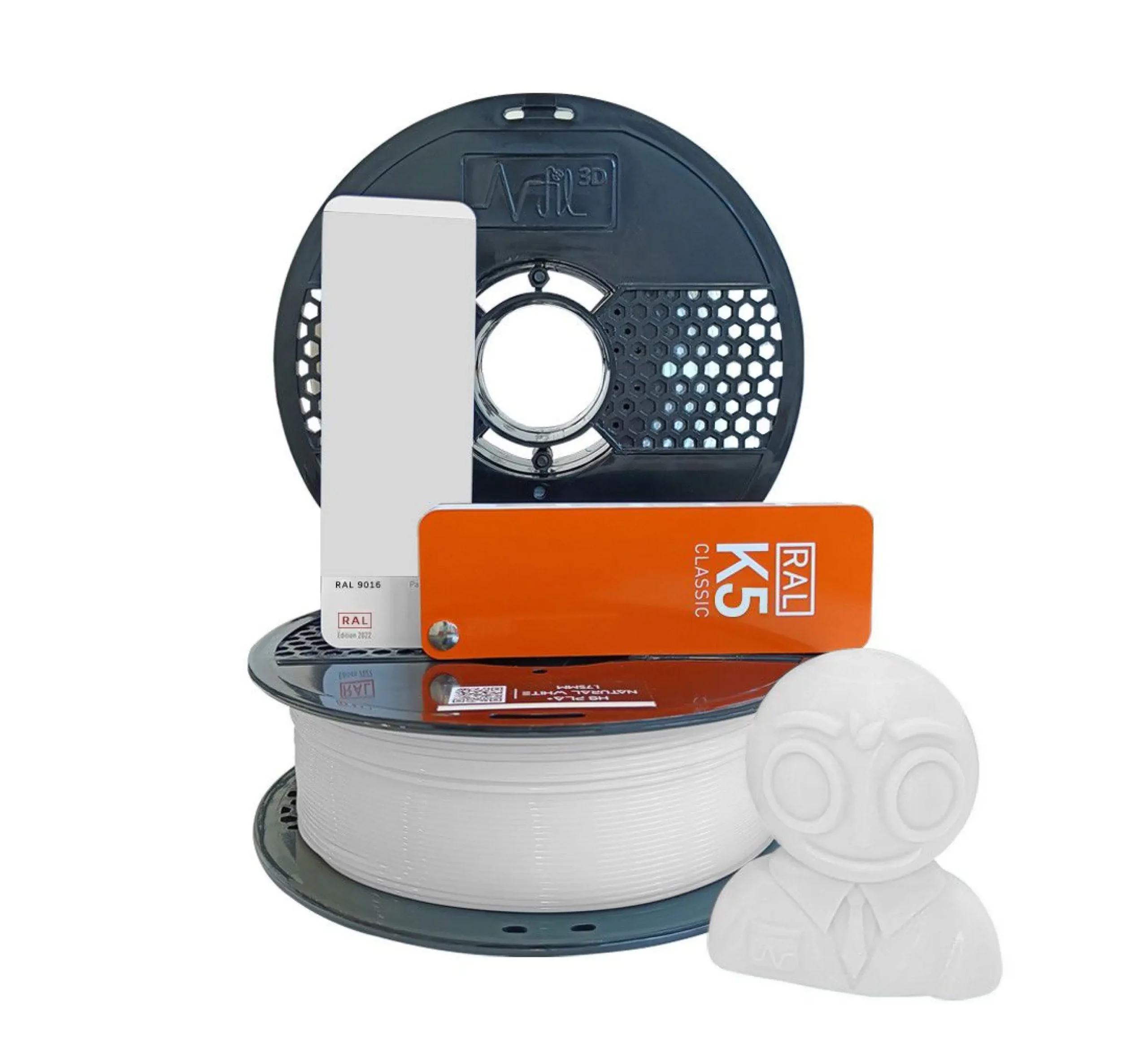
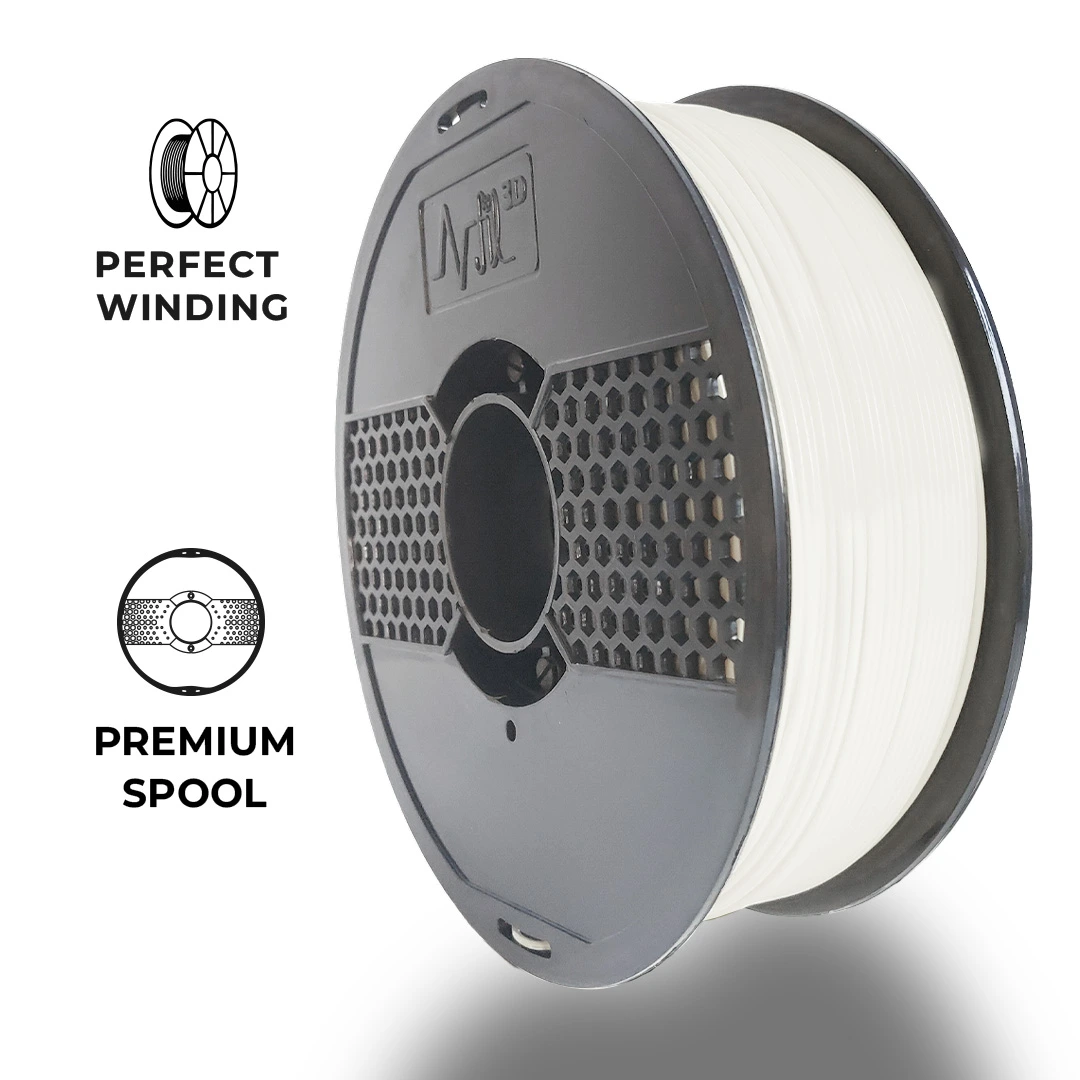
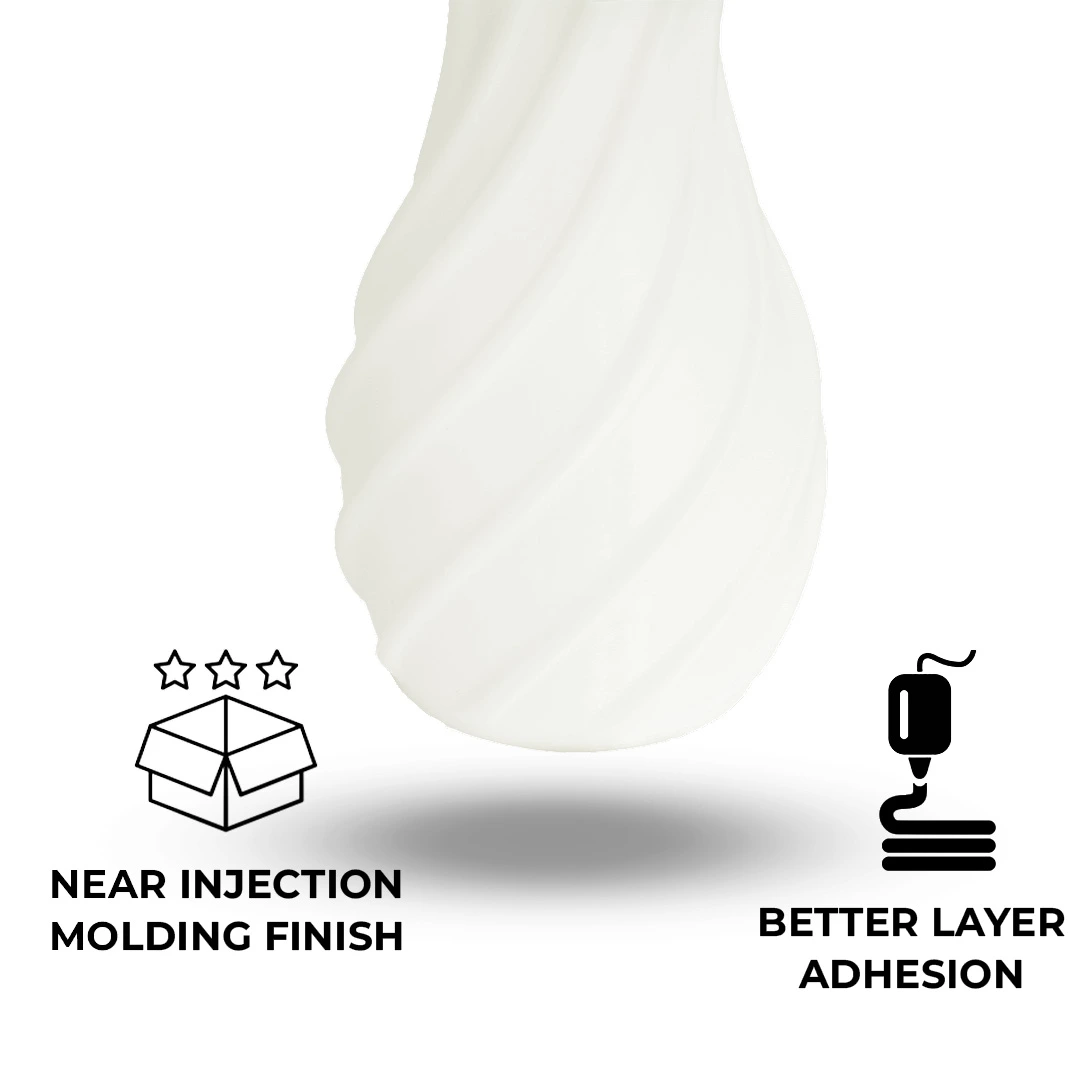
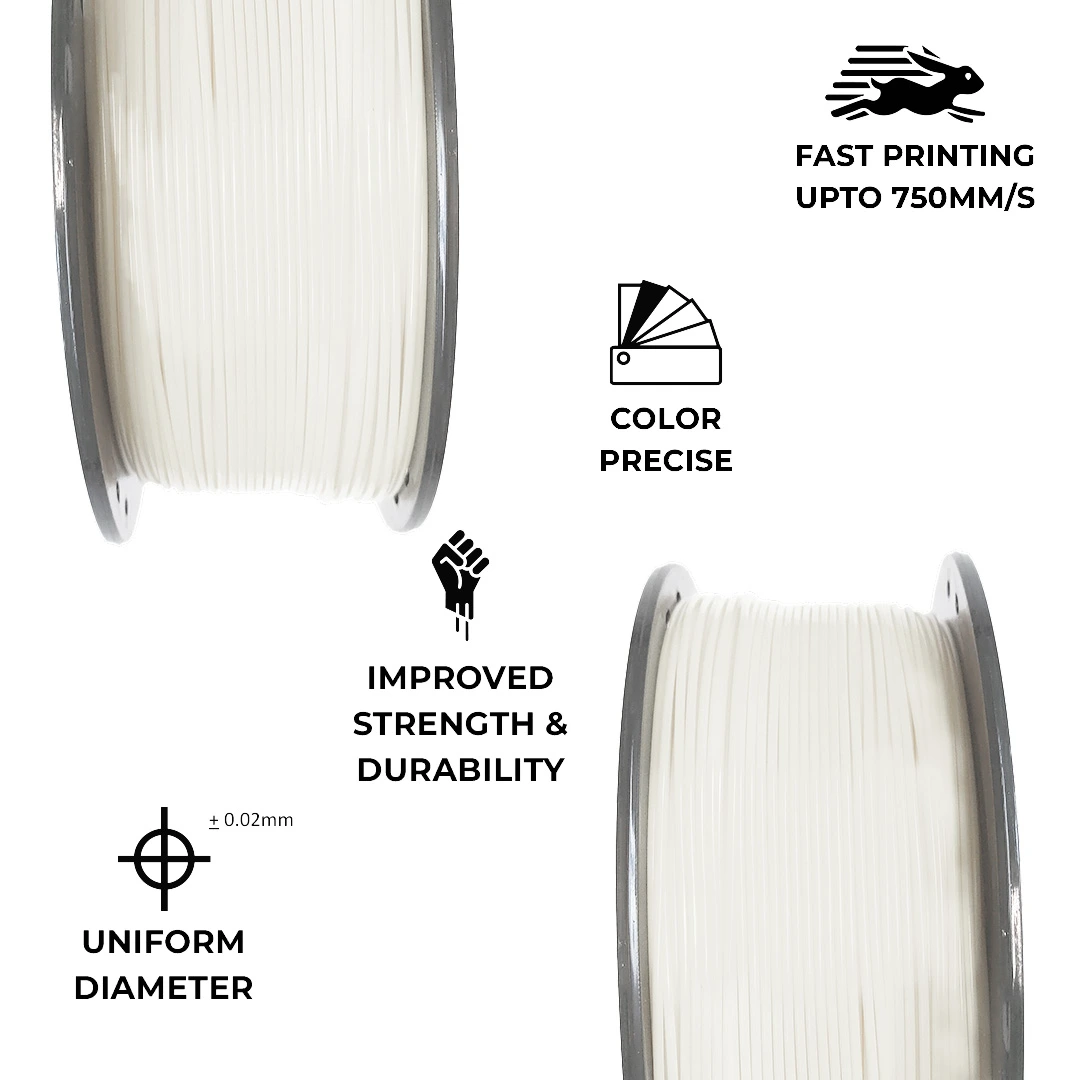
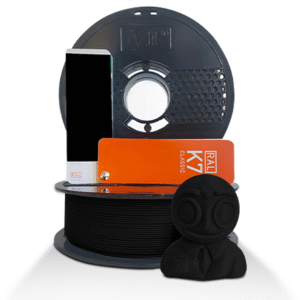
HIPS Natural White by NFIL3D is a High Impact Polystyrene 3D printer filament designed for makers, engineers, designers and professionals working with compatible FDM and FFF printing systems. Its clean Natural White appearance makes it a versatile choice for prototype models, architectural designs, demonstration components and removable support structures in suitable multi-material printing workflows.
HIPS, or High Impact Polystyrene, is an engineering-oriented thermoplastic known for its useful combination of rigidity, relatively low weight and ease of post-processing. It is especially valued as a soluble support material because HIPS can be dissolved using d-limonene under appropriate conditions.
HIPS Natural White features a nominal 1.75mm filament diameter, a manufacturer-advertised ±0.015mm diameter tolerance and a specified full 1kg net filament weight. NFIL3D also highlights consistent colour, two included desiccants and more than 30 years of experience in polymer processing.
The filament is intended for properly configured printers capable of handling HIPS processing temperatures. Successful printing depends on suitable hotend temperatures, a heated bed, adhesion settings and appropriate ventilation.
Why Choose HIPS Natural White?
HIPS Natural White provides a practical material option for users who need removable support structures or lightweight standalone 3D printed models.
Unlike PLA, HIPS belongs to the polystyrene family. Its material behaviour, printing requirements and post-processing characteristics differ from those of standard PLA filament.
One of its distinguishing benefits is compatibility with d-limonene-based support removal in carefully selected multi-material workflows. This can help with models containing internal cavities, complicated overhangs or areas where mechanically removing supports would be difficult.
The Natural White colour also offers a clean appearance for presentation models, technical prototypes and customized designs.
HIPS is not water-soluble. The selected solvent can also affect certain model materials, including some ABS and ASA formulations, so compatibility testing is essential before using it as a removable support.
Key Features and Benefits of HIPS Natural White
1. High Impact Polystyrene Material
HIPS Natural White is manufactured from the HIPS material category, which stands for High Impact Polystyrene.
HIPS is a modified polystyrene thermoplastic that typically includes rubber components to improve toughness compared with unmodified polystyrene.
It provides useful rigidity and moderate mechanical performance for suitable printing applications.
The original product description claims higher strength than regular PLA, but a reliable comparison requires product-specific mechanical testing.
Strength, stiffness, impact resistance and flexibility are different material properties. HIPS should not automatically be described as stronger than PLA in every category.
For functional printing projects, the finished part should be evaluated for its intended load and operating environment.
2. Natural White Colour
HIPS Natural White features a neutral white appearance that is suitable for both technical and creative designs.
The colour works well for architectural miniatures, display structures, equipment mock-ups and conceptual product housings.
White surfaces can make geometric details, edges and model contours easier to examine under suitable lighting.
This colour can also be used alongside black, grey and brightly coloured materials in multi-part prototypes.
Natural White and Snow White are separately named NFIL3D variants. Their actual shades should be compared using physical samples if precise colour matching is important.
3. Dissolvable Support Material
One of the most useful characteristics of HIPS Natural White is its ability to dissolve in d-limonene.
In compatible multi-material printing setups, HIPS may be used to create temporary support structures for difficult overhangs and internal geometries.
After printing, the supports can be removed using an appropriate solvent process.
This can reduce the need to manually break away support material from delicate model surfaces.
However, d-limonene can also damage or weaken some commonly printed polymers. In particular, certain ABS and ASA formulations can be affected.
Always test the selected model filament and HIPS support combination before beginning a large or complex print.
Use the solvent only with suitable protective equipment, ventilation and chemical-handling procedures.
4. Precision 1.75mm Diameter
HIPS Natural White has a nominal filament diameter of 1.75mm.
NFIL3D advertises a dimensional tolerance of ±0.015mm.
Consistent diameter helps a calibrated extrusion system deliver more predictable material volume.
Slicing software calculates extrusion based on filament diameter, nozzle width, layer height and selected flow settings.
Large diameter variations may lead to uneven material flow, inconsistent line widths or surface irregularities.
The advertised ±0.015mm specification refers to filament diameter tolerance, not guaranteed accuracy of completed 3D printed parts.
Printed dimensions also depend on cooling, shrinkage, machine calibration and model geometry.
5. Printing Speed and Extrusion Control
HIPS Natural White can be printed on properly configured FDM and FFF printers using an appropriate HIPS material profile.
The original product description advertises speeds from 50mm/s to 750mm/s.
However, a maximum speed of 750mm/s has not been independently verified for this particular filament.
Actual printing speed depends on the printer’s motion system, hotend melting capacity, nozzle size, layer height and material flow requirements.
Users should begin with moderate, well-calibrated printing speeds and increase them gradually.
For support structures, the print speed should also be compatible with the model material and multi-material extrusion system.
6. Lightweight Material Characteristics
HIPS is often valued for its comparatively lightweight material characteristics and moderate rigidity.
This makes it relevant to presentation models, conceptual housings and non-critical printed components.
The actual mass of a completed part depends on material density, infill, wall thickness and model size.
Lightweight does not mean that a finished HIPS object is automatically suitable for demanding structural applications.
Always select a material based on the finished component’s mechanical requirements.
7. Moisture Management with Two Desiccants
HIPS Natural White is described as being supplied with two desiccants.
Desiccants are intended to help manage humidity exposure when filament is stored in suitable sealed packaging.
The original product description says “No Moisture,” but this should not be treated as a permanent guarantee.
Storage conditions can affect the processing quality of many filament materials.
Keep unused HIPS filament in an airtight container or sealed protective bag with suitable desiccant.
Although HIPS is generally less moisture-sensitive than highly hygroscopic support filaments such as PVA, dry storage is still recommended.
If print quality deteriorates after extended storage, check the material’s condition and follow the manufacturer’s drying instructions.
8. Full 1kg Net Filament Weight
Each spool of HIPS Natural White is specified with 1kg net weight of usable filament.
The net weight excludes the empty spool and external packaging.
This quantity helps users estimate material requirements before starting printing projects.
For multi-material printing, a slicer can estimate the amount of HIPS required for support structures.
Actual material use depends on overhang geometry, support density, interface settings, wall count and infill.
9. Consistent Natural White Colour
NFIL3D emphasizes consistent colour as one of its filament manufacturing features.
Colour consistency is useful when multiple model components need to match within the same assembly.
HIPS Natural White can be used for matching architectural elements, product prototypes and decorative designs.
Printing temperature, layer height, cooling and surface finish may also influence the final appearance.
For colour-critical printing, compare physical samples before large production runs.
10. Polymer Processing Experience
NFIL3D highlights more than 30 years of experience in polymer materials, additives and processing.
This background supports the brand’s approach to filament production and material formulation.
Its HIPS range provides material options for makers exploring soluble supports, engineering concepts and creative FDM printing projects.
Applications of HIPS Natural White
Soluble Support Structures for Complex Prints
HIPS Natural White can be used as removable support material in compatible dual-extrusion or multi-material printing systems.
Complex models with cavities, deep overhangs and difficult-to-reach support areas may benefit from soluble supports.
Verify the model material’s resistance to d-limonene before beginning solvent removal.
Engineering Prototypes
Create conceptual parts, fit-testing samples, product mock-ups and non-critical mechanical demonstration models.
HIPS can be useful where moderate rigidity and prototype appearance matter.
Architectural Models and Scale Structures
HIPS Natural White can be used for miniature buildings, structures, industrial models and architectural presentation pieces.
The neutral white finish helps emphasize geometry and design details.
Product Housings and Covers
Produce appearance prototypes of device covers, equipment housings and conceptual enclosures.
Functional electrical and thermal requirements must be evaluated separately.
Creative Models and Sculptures
Create geometric shapes, decorative objects, customized display pieces and hobby models.
HIPS can also be sanded or post-processed using appropriate methods.
Educational and STEM Projects
HIPS Natural White can support projects involving material comparison, prototype development, mechanical demonstrations and 3D printing education.
Heating HIPS and handling solvents require suitable supervision, ventilation and safety precautions.
HIPS Natural White Technical Specifications
| Parameter | Specification |
|---|---|
| Product Name | HIPS Natural White 1.75mm |
| Brand | NFIL3D |
| Material Type | High Impact Polystyrene |
| Colour | Natural White |
| Printing Technology | FDM / FFF |
| Nominal Filament Diameter | 1.75mm |
| Advertised Diameter Tolerance | ±0.015mm |
| Specified Net Filament Weight | 1kg |
| Included Desiccants | 2 |
| Colour Consistency | Manufacturer-Advertised |
| Manufacturer Experience | 30+ Years in Polymer Processing – brand claim |
| Soluble Support Use | Possible in compatible multi-material systems |
| Solvent | d-Limonene, subject to compatibility testing |
| Water Solubility | Not water-soluble |
| Heated Bed | Recommended |
| Enclosure | Helpful for stable printing conditions |
| Nozzle Temperature | Follow NFIL3D’s material-specific recommendations |
| Bed Temperature | Follow NFIL3D’s material-specific recommendations |
| Maximum Printing Speed | Not independently verified |
| Typical Applications | Removable Supports, Prototypes, Models and Accessories |
Recommended Printing Settings for HIPS Natural White
HIPS Natural White requires a suitable HIPS material profile rather than standard PLA settings.
Nozzle Temperature
Use the temperature range recommended by NFIL3D for this specific filament.
For general reference, Prusa lists approximately 225–255°C for its HIPS material.
This is a reference range from another HIPS formulation, not a verified NFIL3D product specification.
Make sure the printer’s hotend is rated for the selected temperature.
Heated Bed Temperature
A compatible heated bed is recommended.
Prusa’s HIPS material guide gives approximately 100–110°C as a reference bed temperature for its material.
The correct temperature for NFIL3D HIPS may differ depending on the formulation, printer and build surface.
Printing Speed
Start with a moderate speed, such as 40–60mm/s, as an initial calibration experiment on a suitable printer.
This is a starting suggestion rather than a manufacturer-verified speed specification.
Increase speed gradually while checking extrusion, first-layer adhesion and surface quality.
Do not assume that 750mm/s is supported without printer-specific and material-specific testing.
Printer Enclosure
A stable printing environment is recommended.
An enclosure can help control cooling and reduce warping on larger models.
Layer Height
A 0.20mm layer height is a practical starting point with a standard 0.4mm nozzle.
Adjust according to the desired surface quality and model geometry.
Cooling Fan
Use the cooling settings recommended by the HIPS material profile.
Excessive cooling may affect layer bonding and dimensional stability.
Bed Adhesion
Use a suitable HIPS-compatible print surface.
A brim may improve adhesion for models with small first-layer contact areas or corners prone to lifting.
Multi-Material Support Settings
For soluble supports, calibrate nozzle alignment, material transitions, support interfaces and adhesion between the model and support materials.
The exact settings depend on the multi-material printer and model filament.
Ventilation
Operate the printer with effective ventilation and suitable emission-control measures.
Heating polystyrene-based materials may release airborne particles and volatile compounds.
Avoid printing in poorly ventilated occupied spaces.
Filament Storage
Keep unused material sealed in dry conditions with suitable desiccant.
For independent material guidance, read the Prusa HIPS Printing Guide.
Tips for Better HIPS Natural White Printing
Before starting a large project, print a small calibration model.
Confirm that the hotend and build plate support the selected HIPS temperature profile.
Clean and prepare the build surface appropriately.
Maintain stable environmental conditions and avoid direct cold drafts.
Use a brim when additional first-layer adhesion is needed.
Monitor extrusion flow and avoid excessive print speeds.
When using HIPS as support material, test adhesion to the model material before a long print.
Check that the finished model will not be damaged by d-limonene before beginning support dissolution.
Use suitable personal protective equipment and ventilation when handling solvents.
Keep the filament stored in dry, sealed packaging.
For the best Natural White appearance, keep the nozzle clean and purge residual dark-coloured filament before switching materials.
Do not use solvent-treated parts in demanding applications until they have been appropriately assessed.
Frequently Asked Questions About HIPS Natural White
What is HIPS Natural White?
HIPS Natural White is an NFIL3D High Impact Polystyrene filament in Natural White colour, designed for compatible 1.75mm FDM and FFF 3D printers.
What is the full form of HIPS?
HIPS stands for High Impact Polystyrene.
Can HIPS Natural White be used as support material?
Yes. HIPS can serve as removable support material in compatible multi-material printing systems, provided the model filament and solvent-removal process are suitable.
Does HIPS Natural White dissolve in water?
No. HIPS is not water-soluble. It can be dissolved using d-limonene under appropriate conditions.
Is HIPS Natural White stronger than PLA?
No universal strength comparison can be guaranteed without relevant test data. HIPS and PLA have different mechanical characteristics.
Can HIPS Natural White print at 750mm/s?
The supplied description advertises this upper speed, but it has not been verified through product-specific testing. Actual speed depends on the material, hotend and printer.
What is the filament diameter?
The nominal diameter is 1.75mm, with an advertised ±0.015mm filament diameter tolerance.
Is HIPS Natural White the same as PLA?
No. HIPS is High Impact Polystyrene, while PLA is Polylactic Acid. Their processing and material properties are different.
Does HIPS Natural White need a heated bed?
A heated bed is recommended for reliable HIPS printing.
How should HIPS Natural White be stored?
Store unused filament in a sealed container or protective bag with suitable desiccant.
Does each spool contain 1kg?
The supplied product specification states a full 1kg net weight of usable filament, excluding spool and packaging.
Buy HIPS Natural White at NFIL3D
HIPS Natural White combines a clean white appearance with the practical characteristics of High Impact Polystyrene.
Its nominal 1.75mm diameter, advertised ±0.015mm filament tolerance, specified 1kg net weight and two included desiccants make it a material option for compatible FDM printing systems.
Whether you are developing engineering prototypes, architectural models, presentation components or suitable soluble support structures, this filament offers versatility for specialized 3D printing workflows.
Explore the NFIL3D HIPS Filament Collection for available colours, including Natural White, Raven Black and Snow White.
Visit the NFIL3D Store for more 3D printer filaments, printers and accessories.


