

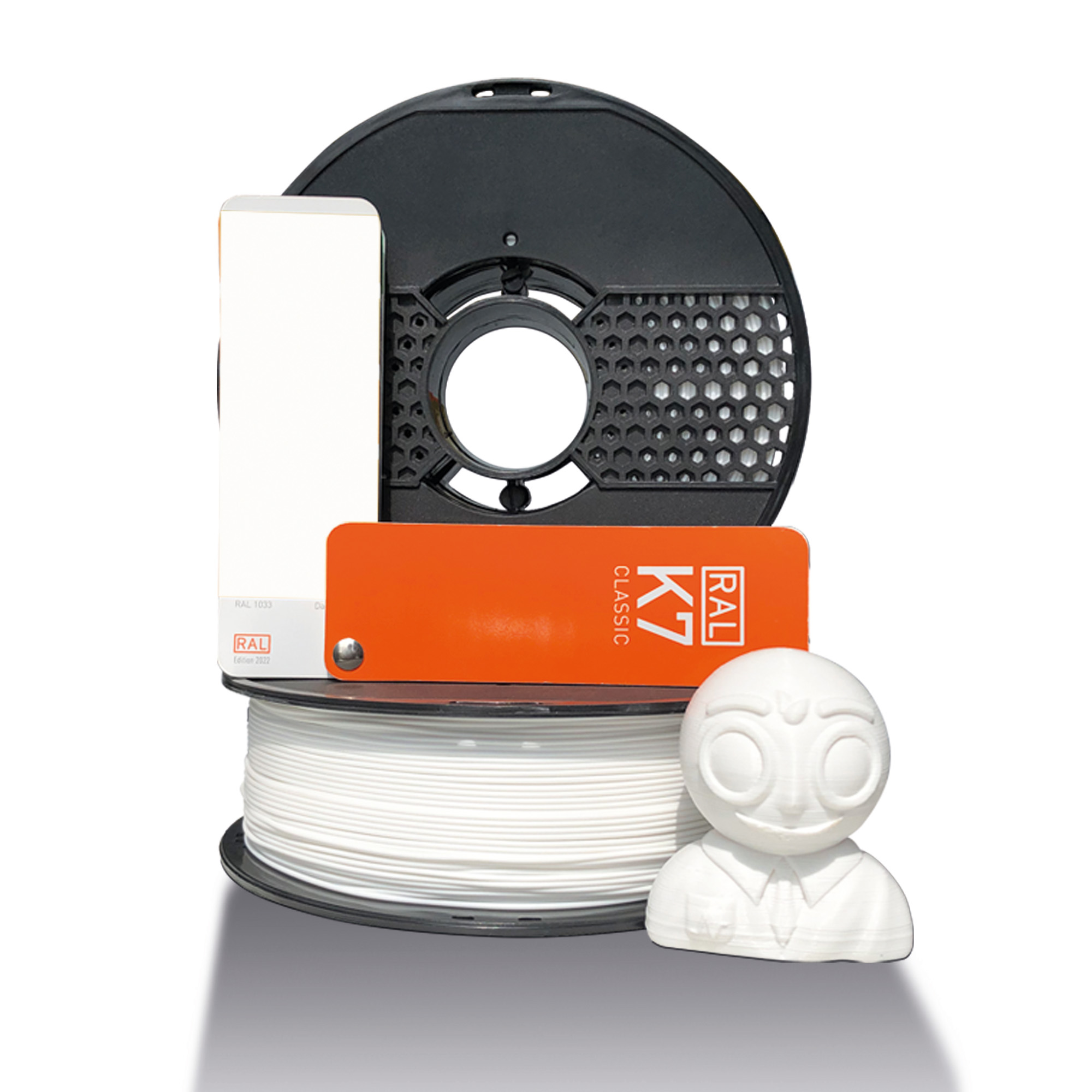
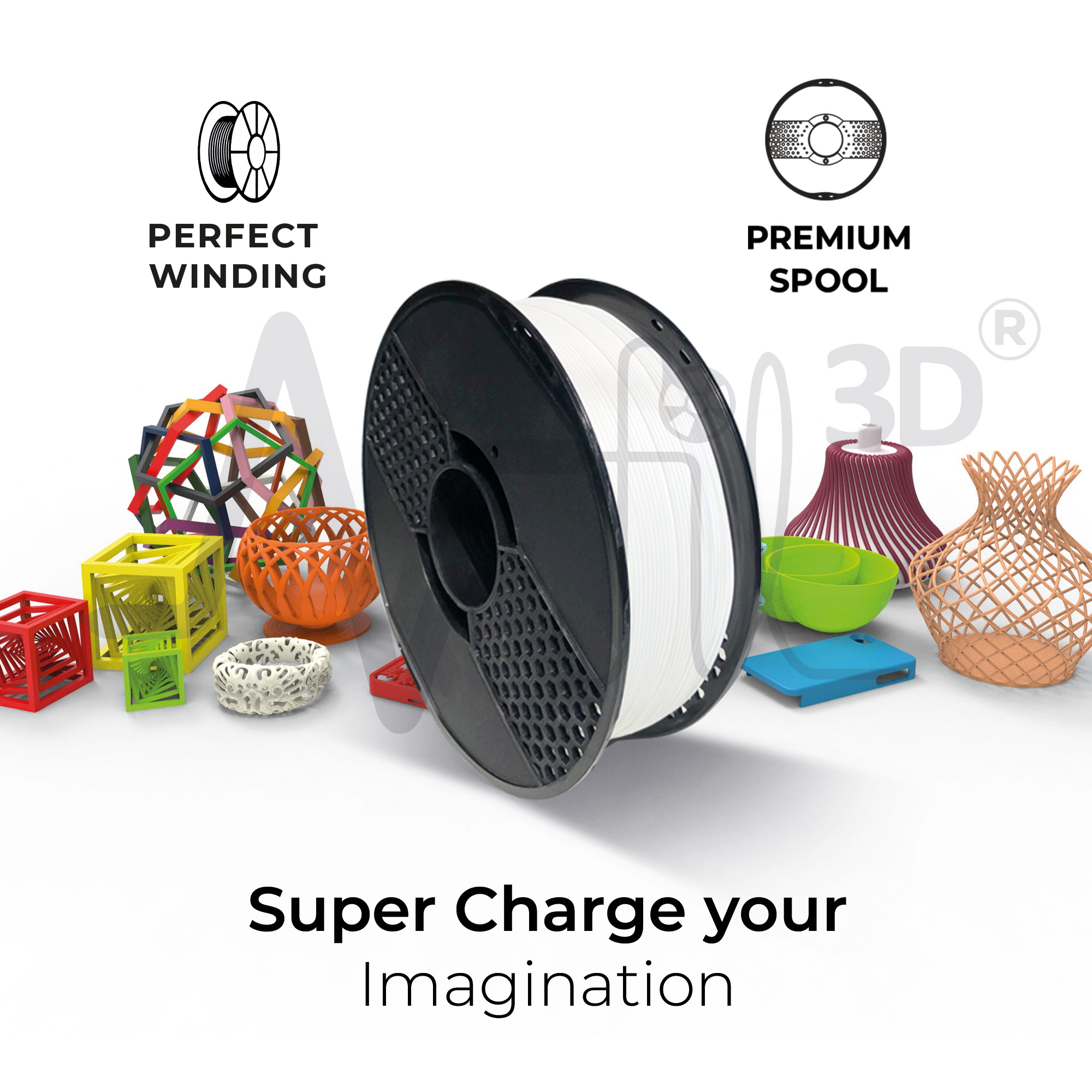
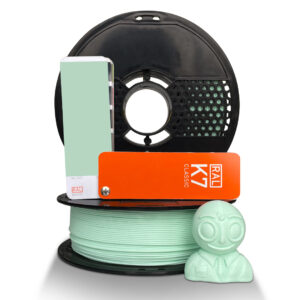
HIPS Snow White by NFIL3D is a High Impact Polystyrene 3D printer filament designed for engineers, designers, professionals and makers looking for a versatile material for technical models, removable supports and creative 3D printing projects. Its clean Snow White colour is suitable for architectural models, engineering prototypes, product mock-ups and customized printed designs.
HIPS stands for High Impact Polystyrene, a modified polystyrene thermoplastic with useful toughness, relatively low weight and moderate mechanical properties. It can be used as a standalone filament or as removable support material in compatible multi-material printing workflows.
HIPS Snow White features a nominal 1.75mm filament diameter, an advertised ±0.015mm diameter tolerance and a specified 1kg net weight of usable filament. NFIL3D also highlights consistent colour, two desiccants for humidity-conscious storage and over 30 years of experience in polymer materials and processing.
Unlike standard PLA, HIPS has different thermal and mechanical characteristics. It is especially useful in selected support applications because it can dissolve in d-limonene.
Why Choose HIPS Snow White?
HIPS Snow White combines the practical properties of High Impact Polystyrene with an attractive white appearance.
The material is suitable for compatible FDM and FFF printers equipped to process HIPS filament.
Its relatively low weight and moderate rigidity can make it useful for models, prototypes and design demonstrations.
One of the main benefits of HIPS is its ability to act as dissolvable support material for suitably selected model filaments.
This helps users explore complex shapes, internal cavities and overhangs that may otherwise require difficult manual support removal.
The Snow White colour also makes the filament useful for professional presentation models and customized decorative projects.
For successful printing, use a compatible hotend, heated bed, appropriate material profile and effective ventilation.
Key Features and Benefits of HIPS Snow White
1. High Impact Polystyrene Material
HIPS Snow White belongs to the High Impact Polystyrene material category.
HIPS is a polystyrene-based thermoplastic modified with rubber components to improve toughness compared with unmodified polystyrene.
It offers useful rigidity and moderate mechanical properties for appropriate 3D printing applications.
The original product description claims higher strength than regular PLA.
However, HIPS and PLA have different mechanical characteristics, and there is no universal strength advantage across every test.
Tensile strength, impact resistance, stiffness and elongation must be evaluated separately.
Without specific comparative test results, a guaranteed strength improvement over PLA should not be claimed.
Finished-part performance also depends on wall thickness, infill, print orientation and interlayer adhesion.
2. Clean Snow White Colour
HIPS Snow White features a clean white appearance for professional prototypes and creative models.
Its colour is suitable for architectural miniatures, product concepts, geometric sculptures, presentation objects and demonstration models.
White surfaces can help designers examine model geometry, edges, curves and visible surface details.
Snow White can also be combined with black, grey, blue and other contrasting filaments in multi-part designs.
NFIL3D advertises consistent colour formulation as one of its product characteristics.
The final appearance may vary according to temperature, layer height, cooling and lighting.
Snow White and Natural White are separately named colour variants, so exact shade matching should be checked using actual samples.
3. Dissolvable Support Material
One of the most valuable characteristics of HIPS Snow White is its potential use as a dissolvable support filament.
HIPS can dissolve in d-limonene, allowing temporary support structures to be removed under suitable conditions.
This characteristic is useful for complex objects containing overhangs, cavities and areas that are difficult to access with conventional support-removal tools.
A dual-extrusion or compatible multi-material printer is generally needed when the model and support structures use different filament types.
However, support compatibility must be checked carefully.
Some ABS and ASA formulations may also be affected by d-limonene, so they are not automatically safe model materials for this process.
HIPS is not water-soluble.
Always test the selected model material before attempting solvent-based support removal.
Use appropriate protective equipment, ventilation and chemical-handling procedures.
4. Precision 1.75mm Filament Diameter
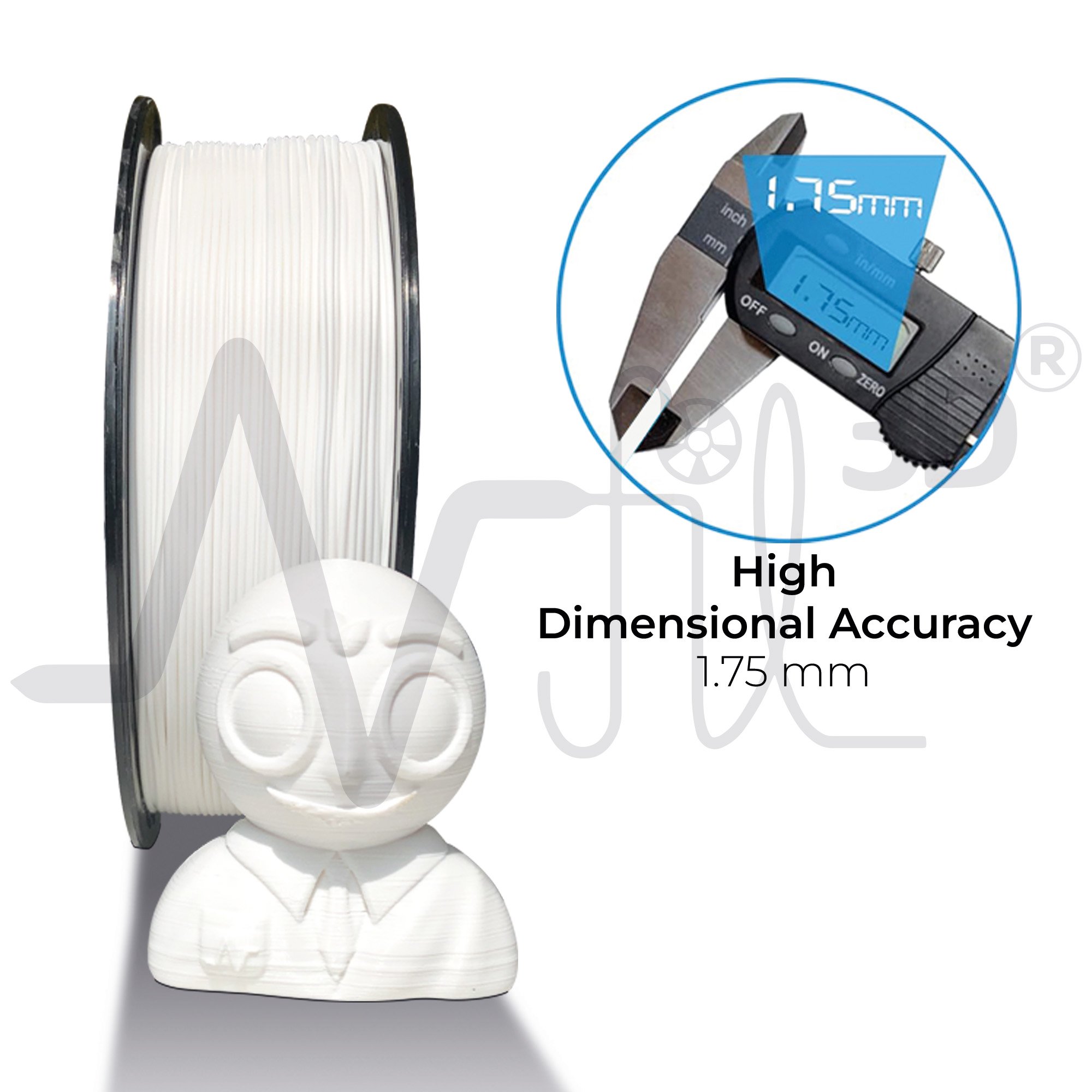
HIPS Snow White has a nominal filament diameter of 1.75mm.
NFIL3D advertises a ±0.015mm filament diameter tolerance.
Consistent diameter helps an appropriately calibrated extruder deliver predictable amounts of material.
Slicing software uses the configured filament diameter to calculate material extrusion for walls, infill and supports.
Significant diameter variations can contribute to uneven extrusion, inconsistent line widths and surface irregularities.
The advertised ±0.015mm specification refers to filament diameter tolerance, not guaranteed dimensional accuracy of the printed object.
Actual model dimensions depend on cooling, shrinkage, machine calibration and geometry.
5. Printing Speed and Extrusion Performance
HIPS Snow White is intended for appropriately configured FDM and FFF printing systems.
The original NFIL3D product description lists a printing speed range of 50mm/s to 750mm/s.
However, the upper value of 750mm/s has not been established through product-specific performance testing.
The achievable printing speed depends on the printer’s motion capabilities, hotend melting capacity, nozzle diameter, layer height and model geometry.
Start with a suitable HIPS slicing profile and moderate speeds.
Increase printing speed gradually after confirming extrusion quality, first-layer adhesion and layer bonding.
A high advertised motion speed does not automatically mean the printer can melt and deposit HIPS reliably at that speed.
6. Lightweight Material Characteristics
HIPS Snow White offers the relatively lightweight characteristics commonly associated with High Impact Polystyrene.
This can be useful when creating presentation models, mechanical concept parts and non-critical printed objects.
The weight of a finished part depends on material density, internal infill and geometry.
The material should not automatically be considered suitable for demanding load-bearing applications.
For functional parts, evaluate the expected mechanical loads and operating conditions.
7. Moisture Management with Two Desiccants
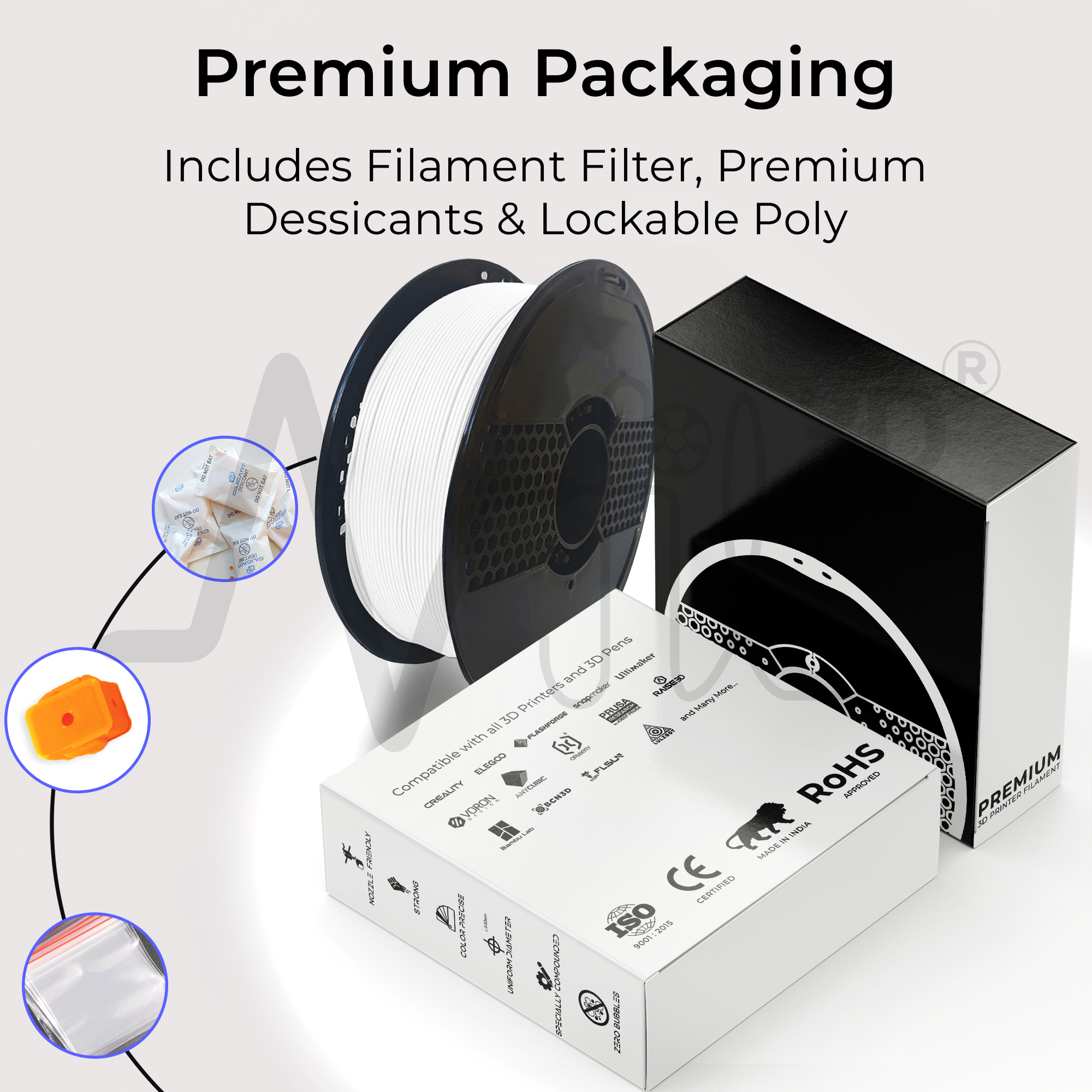
HIPS Snow White is described as being supplied with two desiccants.
Desiccants help reduce humidity exposure when filament is stored in suitable sealed packaging.
The original description states “No Moisture,” but this should not be interpreted as a permanent guarantee.
Although HIPS is generally less hygroscopic than certain other support materials, dry storage is still recommended.
After opening the spool, keep unused filament in an airtight container or sealed protective bag with suitable desiccant.
If printing quality deteriorates during storage, review filament condition and follow NFIL3D’s handling recommendations.
8. Full 1kg Net Filament Weight
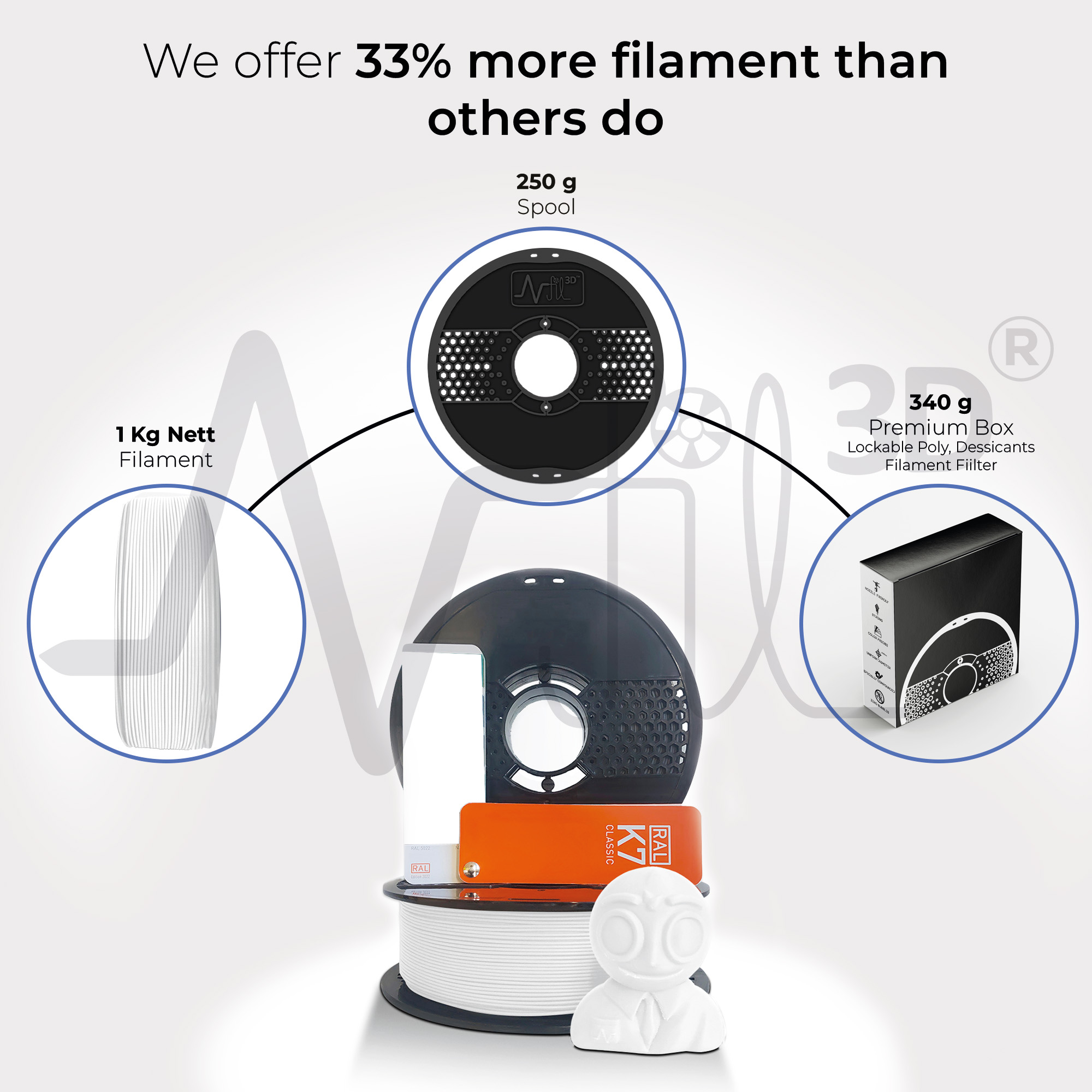
Each spool of HIPS Snow White is specified with 1kg net weight of usable 3D printer filament.
The net weight excludes the empty spool and external packaging.
This quantity helps users estimate filament requirements for larger projects and repeated printing tasks.
For multi-material printing, a slicer can estimate how much HIPS support material will be needed.
Actual consumption depends on model geometry, support density, wall thickness, infill and slicing settings.
9. Consistent Snow White Colour
Colour consistency is useful when several printed objects need to have a matching appearance.
NFIL3D highlights consistent colour formulation as one of its manufacturing features.
HIPS Snow White can be used for matching architectural components, presentation models and decorative objects.
Maintaining similar nozzle temperatures, layer heights and outer-wall settings can also support a more consistent-looking surface finish.
For colour-sensitive projects, compare printed samples before beginning batch production.
10. Backed by 30+ Years of Polymer Experience
NFIL3D highlights more than 30 years of experience in polymer raw materials, additives and material processing.
This background supports its approach to material formulation and filament manufacturing.
The HIPS range provides multiple colour options for prototype development, removable support applications and creative printing.
Applications of HIPS Snow White
Soluble Supports for Complex 3D Prints
HIPS Snow White may be used to create removable support structures in compatible dual-extrusion or multi-material printing systems.
Temporary supports can help with intricate overhangs, internal cavities and other geometries where manual support removal is difficult.
Check model-material compatibility before using d-limonene to remove supports.
Engineering Prototypes and Mechanical Models
HIPS Snow White can be considered for engineering mock-ups, fit-testing parts, product concepts and non-critical mechanical demonstrations.
The white appearance makes the geometry of a prototype easier to examine.
Architectural Models and Miniatures
HIPS Snow White is suitable for miniature buildings, structural concepts, scale models and architectural presentation pieces.
The neutral white colour gives models a clean and professional appearance.
Product Housings and Equipment Mock-Ups
Create appearance prototypes of device covers, equipment housings and industrial product designs.
Functional mechanical, electrical and thermal requirements should be evaluated separately.
Robotics and Automation Concepts
Use the filament for robot housing mock-ups, mechanical demonstration objects and suitable non-critical design components.
Decorative Models and Creative Objects
HIPS Snow White can be used for geometric sculptures, customized display pieces, decorative components and hobby models.
The material can also be sanded and finished using suitable post-processing methods.
Educational and STEM Projects
Develop teaching aids, mechanical demonstration models and 3D printing projects that explore material behaviour and removable supports.
Heating HIPS and handling solvents require appropriate supervision and safety precautions.
HIPS Snow White Technical Specifications
| Parameter | Specification |
|---|---|
| Product Name | HIPS Snow White 1.75mm |
| Brand | NFIL3D |
| Material Type | High Impact Polystyrene |
| Colour | Snow White |
| Printing Technology | FDM / FFF |
| Nominal Filament Diameter | 1.75mm |
| Advertised Diameter Tolerance | ±0.015mm |
| Specified Net Filament Weight | 1kg |
| Included Desiccants | 2 |
| Colour Consistency | Manufacturer-Advertised |
| Polymer Experience | 30+ Years – manufacturer statement |
| Soluble Support Application | Suitable with compatible materials and equipment |
| HIPS Solvent | d-Limonene |
| Water-Soluble | No |
| Heated Bed | Recommended |
| Printer Enclosure | Helpful for thermal stability |
| Maximum Printing Speed | 750mm/s manufacturer claim; not independently verified |
| Nozzle Temperature | Follow NFIL3D’s product-specific recommendations |
| Bed Temperature | Follow NFIL3D’s product-specific recommendations |
| Applications | Supports, Prototypes, Models and Accessories |
Recommended Printing Settings for HIPS Snow White
For dependable results with HIPS Snow White, use a compatible printer and begin with an appropriate HIPS material profile.
Nozzle Temperature
Follow NFIL3D’s recommended temperature settings for this filament.
NFIL3D’s general HIPS getting-started guide lists 220°C as a reference nozzle temperature.
The manufacturer’s material guide should be used alongside printer-specific calibration.
A temperature tower can help identify suitable processing conditions.
Different HIPS formulations may require different temperatures.
Heated Bed Temperature
A compatible heated bed is recommended for HIPS printing.
For independent reference, Prusa lists approximately 100–110°C for its own HIPS formulation.
This is not a verified bed-temperature range for this specific NFIL3D product.
Follow NFIL3D’s technical data and the build-surface manufacturer’s instructions.
Printing Speed
HIPS Snow White should initially be printed at a moderate speed.
A starting range around 40–60mm/s may be useful for calibration on a conventional compatible FDM printer.
This is an initial printing suggestion rather than a product-specific guaranteed speed.
Increase gradually after confirming proper extrusion and bed adhesion.
Do not assume that the advertised upper limit of 750mm/s is achievable without testing the actual printer and material.
Printer Enclosure
Stable ambient temperatures can improve printing consistency.
An enclosure may help reduce cooling-related problems, especially with larger models.
Layer Height
A 0.20mm layer height is a practical starting point for a standard 0.4mm nozzle.
Smaller layer heights may improve detail, while larger layers can reduce the number of layers needed.
Cooling Fan
Use cooling settings appropriate for the selected HIPS profile.
Excessive cooling may affect interlayer bonding and dimensional stability.
Bed Adhesion
Use a suitable HIPS-compatible build surface.
For models with limited bed contact or corners prone to lifting, a brim may improve adhesion.
Multi-Material Support Settings
Calibrate nozzle alignment, tool changes, support interfaces and material transitions before attempting complex support prints.
Test adhesion between HIPS and the chosen model material.
Ventilation and Emission Control
Heating HIPS can release particles and volatile compounds.
Use effective ventilation and suitable emission-control measures.
Avoid operating the printer in poorly ventilated occupied spaces.
Filament Storage
Store unused HIPS filament in sealed, dry conditions with suitable desiccant.
For additional material information, read the Prusa HIPS Material Guide.
Tips for Better HIPS Snow White Prints
Start with a small calibration model before printing a large object.
Check the printer’s hotend and bed-temperature capabilities.
Keep the build plate clean and use a compatible adhesion method.
Avoid direct cold drafts during printing.
Use moderate speeds until material flow and layer bonding are calibrated.
If corners lift, review bed adhesion, nozzle height and thermal conditions.
For large flat-bottomed models, consider using a brim.
When using HIPS as soluble support material, test the model filament’s resistance to d-limonene before processing the finished print.
Use appropriate gloves, eye protection and ventilation while handling solvents.
When switching from black or another dark filament to Snow White, purge the nozzle thoroughly to reduce pigment contamination.
Keep the printing area clean because unwanted marks may be more visible on white objects.
Store the filament in sealed packaging between printing sessions.
Evaluate completed models before using them in demanding mechanical or thermal applications.
Frequently Asked Questions About HIPS Snow White
What is HIPS Snow White?
HIPS Snow White is an NFIL3D High Impact Polystyrene 3D printer filament in Snow White colour, intended for compatible 1.75mm FDM and FFF printers.
What is the full form of HIPS?
HIPS stands for High Impact Polystyrene.
Can HIPS Snow White be used as soluble support material?
Yes. HIPS can be used as removable support material in compatible multi-material printing workflows, provided the main model material and solvent-removal method are suitable.
Does HIPS Snow White dissolve in water?
No. HIPS is not water-soluble. It can dissolve in d-limonene under appropriate conditions.
Is HIPS Snow White stronger than PLA?
There is no universal strength comparison. HIPS and PLA have different material properties, and an exact comparison requires relevant test data.
Can HIPS Snow White print at 750mm/s?
The existing product description advertises this maximum speed, but its performance at 750mm/s has not been independently verified.
What is the filament diameter?
The nominal diameter is 1.75mm, with an advertised ±0.015mm filament diameter tolerance.
Does HIPS Snow White require a heated bed?
A compatible heated bed is recommended for reliable HIPS printing.
Can HIPS Snow White be used with ABS supports?
HIPS can serve as support material in some ABS workflows, but d-limonene may also affect certain ABS formulations. Test material compatibility before use.
Does each spool contain 1kg of filament?
The manufacturer specifies 1kg net filament weight, excluding spool and external packaging.
How should HIPS Snow White be stored?
Store unused filament in an airtight container or sealed protective bag with suitable desiccant.
Buy HIPS Snow White at NFIL3D
HIPS Snow White combines an attractive white appearance with the practical characteristics of High Impact Polystyrene.
With its nominal 1.75mm diameter, advertised ±0.015mm filament tolerance, specified 1kg net weight and two included desiccants, it is an option for compatible FDM printing projects.
Whether you are developing engineering prototypes, architectural models, creative objects or suitable dissolvable support structures, Snow White offers a versatile material choice.
Explore the NFIL3D HIPS Filament Collection for additional colours, including Natural White and Raven Black.
Visit the NFIL3D Store for more filaments, 3D printers and accessories.


