

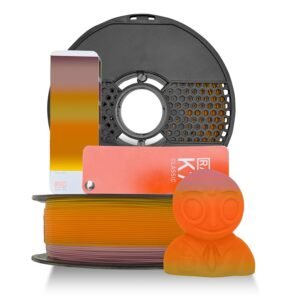


Carbon Fiber PLA+ Black by NFIL3D is a carbon-fiber-reinforced PLA+ 3D printing filament developed for makers, engineers, designers and professionals seeking a distinctive black finish and enhanced rigidity-focused material characteristics. Combining a PLA+ polymer base with carbon-fiber reinforcement, this composite filament is intended for suitable engineering prototypes, design models, lightweight structural concepts and technical 3D printing projects.
Its 1.75mm nominal diameter is designed for compatible FDM and FFF 3D printers equipped to process carbon-fiber-filled materials.
Carbon-fiber composites can offer useful stiffness and dimensional-stability characteristics, although actual mechanical performance depends on fiber content, formulation, print orientation and processing conditions.
Carbon Fiber PLA+ Black is an attractive choice for users who want to explore the benefits of reinforced PLA-based filament while maintaining the versatility of desktop 3D printing.
Why Choose Carbon Fiber PLA+ Black?
Carbon Fiber PLA+ Black combines a refined black appearance with the design possibilities of a carbon-fiber-reinforced polymer.
Conventional PLA+ is widely used for models, prototypes and decorative objects. Carbon-fiber-filled PLA+ introduces reinforcing fibers that can change the stiffness, dimensional stability and surface characteristics of printed material.
For engineering mock-ups, dimensional stability and rigidity are often important considerations.
For product designers, carbon-fiber-filled filament provides an alternative material for prototype housings, mechanical-looking objects and presentation components.
For hobbyists, its black appearance is useful for model vehicles, RC accessories, technical models and customized printed objects.
However, carbon-fiber reinforcement does not guarantee improved performance in every mechanical property. Some carbon-filled filaments can be more brittle than their unfilled counterparts.
Users should evaluate finished parts according to the specific application’s requirements.
Key Features of Carbon Fiber PLA+ Black
1. Carbon-Fiber-Reinforced PLA+ Material
A defining feature of Carbon Fiber PLA+ Black is the combination of a PLA+ polymer base with carbon-fiber reinforcement.
Carbon fibers are used in many composite materials to modify mechanical and dimensional characteristics.
In 3D printing, filled polymers can exhibit increased stiffness and different shrinkage behaviour compared with unfilled materials.
This can be useful for selected technical prototypes, housings, model components and design concepts.
Actual performance depends on fiber type, concentration, distribution and the surrounding polymer formulation.
The carbon-fiber percentage for this NFIL3D product should be confirmed through its technical data sheet.
Carbon-fiber-reinforced PLA+ should not be confused with continuous-carbon-fiber printing systems or fully structural carbon-fiber laminates.
2. Enhanced Rigidity for Suitable Designs
Carbon Fiber PLA+ Black is intended for projects where greater rigidity may be desirable.
Stiffer materials can help certain parts retain their shape under moderate loads.
Potential applications include prototype brackets, conceptual housings, mounting mock-ups and non-critical mechanical components.
However, rigidity is different from toughness or impact resistance.
A material can become stiffer while also becoming more brittle.
The final stiffness and strength of a printed part depend on wall thickness, infill, layer orientation, geometry and layer adhesion.
For engineering applications, compare test prints and evaluate the finished part before using it under load.
3. Refined Black Appearance
Carbon Fiber PLA+ Black features a dark black appearance suitable for modern technical and decorative objects.
Black is a versatile colour for engineering mock-ups, product concepts, miniature vehicles and professional-looking presentation models.
The material can complement metallic, white, grey or other contrasting components in multi-part assemblies.
Carbon-fiber-filled PLA filaments may produce a visually distinctive surface compared with ordinary PLA, depending on formulation and printing conditions.
The exact surface sheen and texture of the NFIL3D filament should be evaluated through printed samples.
A matte finish, visible carbon texture or particular surface roughness should not be guaranteed unless established by actual product data.
4. Dimensional Stability and Warping Considerations
Carbon-fiber-filled polymers can exhibit useful dimensional-stability characteristics.
In suitable applications, reinforcement may help reduce some shrinkage-related effects.
This can benefit models containing flat surfaces, mechanical-looking features and prototype geometries.
However, Carbon Fiber PLA+ Black should not be advertised as completely warp-free.
Warping can still occur because of incorrect bed adhesion, unsuitable cooling, printing temperature or model geometry.
A clean build plate, appropriate first-layer settings and a suitable material profile remain essential for consistent results.
5. Hardened Nozzle Recommended
Carbon-fiber-filled filament can be abrasive.
A standard brass nozzle may wear faster when exposed to reinforcing fibers, potentially changing the nozzle opening and affecting print quality.
For Carbon Fiber PLA+ Black, a hardened steel or another suitable wear-resistant nozzle is recommended.
The nozzle diameter should also be selected according to the manufacturer’s technical specifications.
A larger nozzle may help reduce clogging risk in some filled formulations, although the actual requirement depends on fiber dimensions and loading.
Keep the nozzle clean and use an extrusion path suitable for abrasive composites.
The manufacturer’s nozzle-friendly description should be understood as a processing objective, not a guarantee of zero clogging or zero nozzle wear.
6. Nominal 1.75mm Filament Diameter
Carbon Fiber PLA+ Black is supplied in a nominal 1.75mm diameter for compatible FDM and FFF 3D printers.
The correct filament diameter is essential for consistent material feeding and extrusion calculations.
NFIL3D’s listing advertises a diameter tolerance of ±0.015mm.
This value describes the manufacturer’s claimed filament-diameter tolerance.
It does not guarantee ±0.015mm dimensional accuracy in finished 3D printed components.
Nozzle wear, extruder calibration, line width, printing orientation and cooling can all influence printed dimensions.
7. Suitable for Technical Prototyping
Carbon Fiber PLA+ Black can be used to explore design concepts where stiffness and material appearance matter.
Engineers can print conceptual brackets, housing samples, equipment mock-ups and suitable non-critical components.
Designers can create rigid-looking presentation models and technical product prototypes.
Hobbyists can develop RC vehicle accessories, miniature machinery and mechanical demonstration models.
Any finished component used in a safety-critical, load-bearing or high-temperature application should undergo appropriate validation.
8. Moisture Management and Storage
NFIL3D lists colour-changing desiccant as a feature of its Carbon Fiber PLA+ Black product.
Desiccants can help reduce humidity exposure when filament is stored in a suitable sealed environment.
PLA-based materials can absorb moisture over time, potentially causing stringing, bubbling or inconsistent extrusion.
A colour-changing desiccant can provide a visual indication of its condition when used according to the supplied instructions.
The presence of desiccant does not guarantee permanently moisture-free filament.
Keep unused filament in an airtight storage container or sealed protective bag with suitable desiccant.
For storage information, read the Prusa Filament Drying Guide.
9. Consistent Colour and Manufacturing Experience
NFIL3D emphasizes controlled colour formulation and dimensional consistency in its filament products.
These characteristics are relevant when printing matching parts for a model or prototype assembly.
The brand also draws on more than 30 years of experience in polymer raw materials, additives and processing.
This background supports its material development and filament-manufacturing approach.
Applications of Carbon Fiber PLA+ Black
Engineering Prototypes and Concept Components
Carbon Fiber PLA+ Black is suitable for non-critical engineering prototypes, equipment mock-ups, conceptual brackets and design validation models.
Its reinforced material concept makes it relevant to rigidity-focused design studies.
RC Cars and Model Accessories
Create suitable RC model covers, decorative parts, concept mounts, miniature vehicle accessories and display components.
Parts exposed to actual impact or demanding loads require testing.
Product Housings and Technical Models
Print conceptual device housings, electronic enclosure prototypes, design models and technical presentation parts.
The black colour complements modern industrial designs.
Robotics and Mechanical Demonstrations
Create robot appearance prototypes, mechanical demonstration pieces and non-critical fixture concepts.
The material’s actual stiffness and mechanical performance should be tested before functional use.
Architectural and Industrial Display Models
Produce miniature industrial structures, technical architectural concepts and engineering display pieces.
Customized Accessories and Creative Projects
Print suitable organizers, decorative models, geometric objects and personalized technical accessories.
Carbon Fiber PLA+ Black Technical Specifications
| Parameter | Specification |
|---|---|
| Product Name | Carbon Fiber PLA+ Black 1.75mm |
| Brand | NFIL3D |
| Material Category | Carbon-Fiber-Reinforced PLA+ |
| Colour | Black |
| Nominal Diameter | 1.75mm |
| Advertised Diameter Tolerance | ±0.015mm |
| Printing Technology | FDM / FFF |
| Recommended Nozzle | Hardened / Wear-Resistant |
| Material Characteristic | Rigidity-Focused Composite |
| Colour Consistency | Manufacturer-Advertised |
| Desiccant | Colour-Changing Desiccant |
| Carbon Fiber Percentage | Not specified |
| Net Filament Weight | Confirm from current product packaging |
| Nozzle Temperature | Follow NFIL3D technical guidance |
| Bed Temperature | Follow NFIL3D technical guidance |
| Applications | Prototypes, Models, Housings and Non-Critical Technical Parts |
Recommended Printing Settings for Carbon Fiber PLA+ Black
For reliable results with Carbon Fiber PLA+ Black, use a profile suitable for the manufacturer’s carbon-fiber-filled PLA+ formulation.
Nozzle Type
Use a hardened steel or another suitable wear-resistant nozzle to reduce accelerated wear from abrasive reinforcement.
Nozzle Diameter
Follow NFIL3D’s product-specific recommendations. Some filled filaments benefit from larger nozzle openings.
Nozzle Temperature
Use the range specified in the NFIL3D technical data sheet or product packaging.
Do not apply nozzle temperatures recommended for carbon-filled nylon or polycarbonate directly to PLA+CF.
Bed Temperature
Select the manufacturer’s recommended heated-bed temperature and maintain a clean print surface.
Layer Height
A 0.20mm layer height can be a calibration starting point when compatible with the selected nozzle and composite formulation.
Printing Speed
Begin with a moderate, printer-supported speed.
Increase speed only after confirming extrusion consistency, surface appearance and suitable layer bonding.
Flow Rate
Calibrate the extrusion multiplier for the actual material and printer.
Retraction
Use a suitable retraction profile and monitor for nozzle clogging or inconsistent feeding.
Part Cooling
Tune cooling to balance surface appearance, overhang performance and interlayer adhesion.
Filament Storage
Keep unused material sealed with suitable desiccant.
For independent information about abrasive carbon-filled materials, see the Prusa Composite Materials Guide.
Tips for Better Carbon Fiber PLA+ Prints
Before printing Carbon Fiber PLA+ Black, confirm that the installed nozzle is suitable for abrasive composite filament.
Check that the hotend and extruder are clean and correctly calibrated.
Begin with a small calibration model to evaluate material flow, layer bonding and surface finish.
For dimensionally sensitive prototypes, measure the finished part and adjust the slicer profile if necessary.
Maintain a suitable first-layer height to reduce clogging and adhesion problems.
When printing detailed models, select appropriate layer heights and wall speeds.
Monitor nozzle wear over extended use.
If the material produces inconsistent extrusion or stringing, review moisture exposure, temperature and retraction.
For mechanical applications, evaluate printed-part stiffness, strength and layer adhesion.
Avoid using the material for safety-critical components without suitable engineering validation.
Frequently Asked Questions
What is Carbon Fiber PLA+ Black?
Carbon Fiber PLA+ Black is an NFIL3D PLA+ composite filament featuring carbon-fiber reinforcement and a black colour for compatible FDM printing.
Is carbon-fiber PLA+ stronger than regular PLA+?
Carbon-fiber reinforcement can change material stiffness and other properties, but improvements are not guaranteed across every strength measure. Comparative results require product-specific test data.
Does it require a hardened nozzle?
A hardened or wear-resistant nozzle is recommended because carbon-fiber-filled materials can be abrasive.
Can I use a regular brass nozzle?
Brass nozzles may wear more quickly when printing abrasive composites. A wear-resistant nozzle is the better choice.
Is Carbon Fiber PLA+ Black completely warp-free?
No. Dimensional stability may improve under suitable conditions, but warping can still occur.
Is it suitable for RC models?
It can be used for suitable RC prototypes and non-critical parts. Demanding components require structural testing.
What is the filament diameter?
The nominal diameter is 1.75mm, with an advertised diameter tolerance of ±0.015mm.
How should the filament be stored?
Store unused filament in a sealed, dry container with suitable desiccant to limit moisture exposure.
Buy Carbon Fiber PLA+ Black at NFIL3D
Carbon Fiber PLA+ Black combines carbon-fiber-reinforced PLA+ material with a refined black appearance for suitable technical and creative printing applications.
It is a useful option for rigidity-focused design concepts, engineering prototypes, product housings, RC model accessories and display components.
Explore the NFIL3D Carbon Fiber PLA+ Collection for product information.
Visit the NFIL3D 3D Printing Store for additional filaments, printers and accessories.


Reviews
There are no reviews yet.