
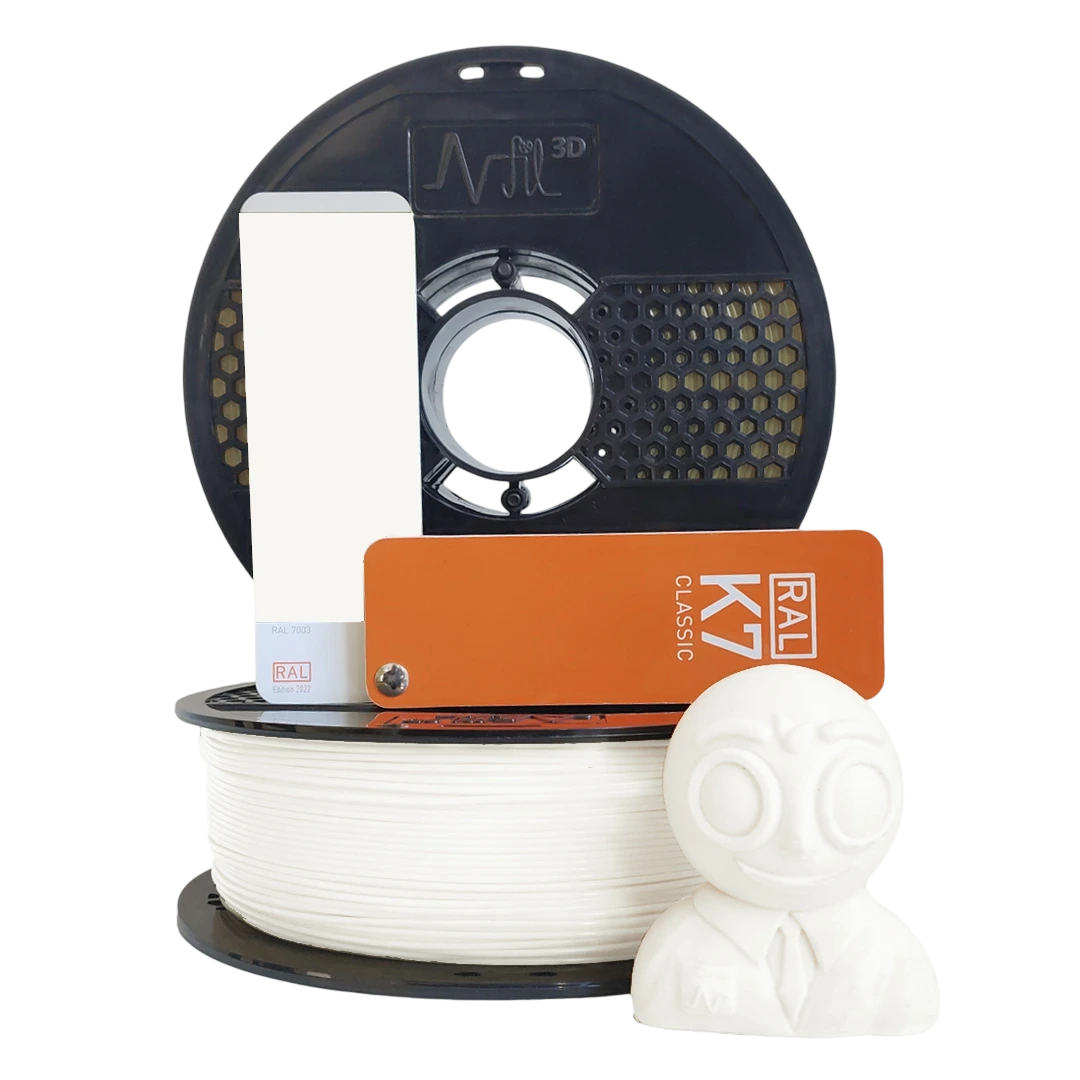

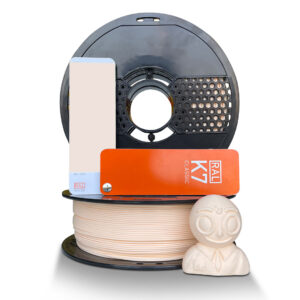
Ultra Light PLA+ Natural White by NFIL3D is a specialized lightweight PLA+ 3D printer filament developed for makers, designers, engineers and hobbyists who want to explore reduced-mass 3D printed components. Its versatile Natural White appearance makes it suitable for model aircraft prototypes, architectural models, cosplay accessories, large decorative sculptures, product mock-ups and educational projects.
As part of NFIL3D’s Ultra Light PLA+ range, this 1.75mm filament is intended for weight-conscious printing applications where balancing material usage, part geometry and practical performance is important.
Its lightweight-focused formulation offers an alternative to conventional PLA+ for suitable applications. Actual printed-part weight, strength and surface quality depend on the material’s characteristics and printing settings.
The Natural White colour provides a neutral appearance that is useful for design presentations, detailed models and projects requiring further painting or finishing.
Why Choose Ultra Light PLA+ Natural White?
Ultra Light PLA+ Natural White combines a clean white appearance with the design possibilities of lightweight-focused FDM printing.
For larger models, reducing printed-part weight can simplify handling, transportation and display installation.
For prototypes, a lighter material may help designers explore different shell structures, wall thicknesses and internal geometries.
For artistic applications, Natural White provides a versatile colour that complements minimalist sculptures, architectural miniatures and decorative accessories.
Unlike conventional PLA+ selected mainly for general-purpose printing, the Ultra Light range is positioned around weight-sensitive designs.
The actual weight advantage should be established through density data or comparative prints, rather than assuming a fixed percentage reduction.
Key Features of Ultra Light PLA+ Natural White
1. Lightweight-Focused Filament Formulation
One of the main design objectives of Ultra Light PLA+ Natural White is reducing the weight of suitable 3D printed objects.
Lightweight components are useful in model making, display structures, wearable accessories and selected prototype applications.
A lower-mass printed part may be easier to transport, assemble or incorporate into a larger model.
However, the actual difference compared with conventional PLA+ depends on filament density, printing conditions, wall thickness and internal structure.
To evaluate the material accurately, users can print an identical model in Ultra Light PLA+ and conventional PLA+ and compare the finished weights.
Specific weight-reduction percentages should only be advertised when supported by measured results.
2. Clean Natural White Colour
Ultra Light PLA+ Natural White features a versatile white appearance suitable for professional and creative projects.
Natural White works particularly well for architectural prototypes, model aircraft concepts, miniature structures, decorative sculptures and presentation models.
The neutral colour can help highlight the shape and contours of printed objects under appropriate lighting.
It also provides a useful starting point for models intended for painting, priming or decorative finishing.
Natural White is a separate product colour from Snow White, Ivory and other named white variants.
The final appearance may vary with print settings, surface texture and lighting.
3. Designed for Strength-to-Weight Optimization
Ultra Light PLA+ Natural White is intended for projects where designers want to balance component mass with useful mechanical performance.
A lightweight structure can be valuable when mass is an important design constraint.
For example, a model aircraft prototype may benefit from reduced component weight, while a large display sculpture may be easier to handle.
However, lighter material does not automatically mean greater strength or stiffness.
Printed-part strength depends on the formulation, print orientation, wall thickness, infill, layer bonding and object geometry.
Weight reduction should be balanced against the mechanical requirements of the final application.
For flight-critical, load-bearing or safety-critical components, material and finished-part testing are essential.
4. Suitable for Large-Scale 3D Printed Models
Large decorative models and architectural structures can become heavy when produced using conventional materials and dense infill.
Ultra Light PLA+ Natural White provides an option for exploring lightweight printing in these applications.
Designers can optimize shells, wall thicknesses and internal structures to reduce unnecessary mass.
This may improve the practicality of transporting or displaying large models.
For suspended displays and wearable objects, suitable mounting systems and safety checks are still required.
5. Versatile for Rapid Prototyping
Ultra Light PLA+ Natural White can be used for appearance prototypes, design mock-ups, concept housings and lightweight model components.
Rapid prototyping enables engineers and designers to evaluate different shapes before committing to a final design.
The lightweight-focused material can add another factor to the design process: printed-part mass.
Designers can compare variations in geometry, shell thickness and internal support structures to find a suitable balance between material usage and durability.
Lower filament density alone does not guarantee faster print times.
Print duration still depends on printer movement, volumetric flow, cooling and selected slicing settings.
6. Nominal 1.75mm Diameter for FDM Printing
Ultra Light PLA+ Natural White has a nominal filament diameter of 1.75mm.
It is intended for compatible FDM and FFF printers capable of processing the specific lightweight PLA+ formulation.
Consistent filament dimensions help support predictable material feeding through a properly calibrated extrusion system.
The product listing also advertises a diameter tolerance of ±0.015mm.
This figure describes filament diameter tolerance, not guaranteed dimensional accuracy of a completed printed part.
The material-specific temperature and flow settings should be confirmed through NFIL3D’s technical recommendations.
7. Nozzle-Friendly Printing
NFIL3D identifies the Natural White variant as nozzle-friendly.
For dependable results, use a clean nozzle, a properly calibrated extrusion system and settings appropriate to the material.
Some lightweight PLA filaments use heat-activated foaming, which may require significant adjustments to extrusion flow and printing temperature.
However, the available NFIL3D product information does not confirm the exact foaming behaviour of this particular formulation.
Users should therefore avoid applying aggressive foaming settings from another manufacturer without testing.
Begin with a compatible material profile and evaluate extrusion quality using small calibration prints.
8. Controlled Colour Consistency
Colour consistency is useful when producing multiple components intended for the same model or decorative collection.
NFIL3D emphasizes consistent colour in its product information.
Ultra Light PLA+ Natural White can be used for matching architectural elements, prototype housings, model sections and display objects.
Maintaining similar nozzle temperatures, layer heights and printing conditions may also help reduce visible differences between printing sessions.
9. Polymer Manufacturing Experience
NFIL3D draws on more than 30 years of experience in polymer raw materials, additives and processing.
This experience supports the brand’s approach to filament development, manufacturing consistency and material selection.
The Ultra Light PLA+ range expands its filament offerings for projects in which low weight is an important design consideration.
Applications of Ultra Light PLA+ Natural White
RC Aircraft and Model Aviation
Ultra Light PLA+ Natural White can be evaluated for model aircraft prototypes, display wings, fuselage concepts and non-critical RC accessories.
Low component mass can be desirable in model aviation, but flight performance also depends on structural rigidity and mechanical reliability.
Any parts intended for actual flight should undergo suitable validation and testing.
Drone Concepts and Lightweight Prototypes
Create visual drone mock-ups, prototype covers, non-critical housings and conceptual components.
Flight-critical drone structures should not be used without appropriate engineering verification.
Architectural Models and Miniature Buildings
Print scale buildings, architectural facades, miniature columns, structural concepts and presentation models.
Natural White is useful for evaluating proportions and surface details.
Cosplay and Wearable Accessories
Produce suitable decorative costume components, prop housings, display armour and wearable accessories.
Lower weight may improve comfort when compared with heavier alternatives, depending on the actual printed-part mass.
Large Decorative Sculptures
Create geometric art, display models, decorative busts and large sculptural objects.
For mounted or suspended models, evaluate the weight and use appropriate supporting hardware.
Educational and STEM Projects
Print engineering examples, mathematical models, architectural demonstrations and lightweight design experiments.
Students and makers can compare identical printed models made from different materials to study mass and structural behaviour.
Ultra Light PLA+ Natural White Technical Specifications
| Parameter | Specification |
|---|---|
| Product Name | Ultra Light PLA+ Natural White 1.75mm |
| Brand | NFIL3D |
| Material Category | Ultra Light PLA+ / PLA+LW |
| Colour | Natural White |
| Nominal Filament Diameter | 1.75mm |
| Advertised Diameter Tolerance | ±0.015mm |
| Printing Technology | FDM / FFF |
| Formulation Focus | Lightweight 3D Printing |
| Product Listing Feature | Nozzle-Friendly |
| Colour Consistency | Manufacturer-Advertised |
| Actual Filament Density | Confirm from NFIL3D technical data |
| Weight Reduction Percentage | Not specified |
| Expansion / Foaming Mechanism | Not confirmed |
| Net Filament Weight | Confirm current SKU packaging |
| Temperature Recommendations | Follow manufacturer guidance |
| Applications | RC Concepts, Prototypes, Cosplay, Architecture and Decor |
Recommended Printing Settings for Ultra Light PLA+
Because Ultra Light PLA+ Natural White is a specialized material, users should follow NFIL3D’s material-specific recommendations rather than automatically using profiles intended for a different lightweight PLA formulation.
Nozzle Temperature: Use the manufacturer-recommended temperature range.
Bed Temperature: Select a suitable heated-bed temperature and maintain a clean build surface.
Layer Height: A 0.20mm layer height with a 0.4mm nozzle may be used as an initial calibration point if compatible with the filament.
Printing Speed: Start with a moderate, reliable speed and adjust after inspecting the print.
Flow Rate: Begin with the recommended flow profile. Do not reduce extrusion dramatically unless the filament’s expansion characteristics have been confirmed.
Wall Thickness: Select enough walls to maintain the required structural performance.
Infill: Choose an infill pattern and density that balance weight, rigidity and application requirements.
Cooling: Adjust part cooling to achieve acceptable overhang quality and layer bonding.
Retraction: Calibrate according to the filament’s observed extrusion behaviour.
Storage: Store unused filament in sealed, dry conditions to reduce humidity exposure.
Understanding Lightweight PLA Printing Behaviour
Different lightweight PLA filaments can behave differently.
Some formulations use heat-activated foaming. During printing, the material expands and may produce lower-density extruded structures.
Other formulations may achieve their lightweight characteristics through different material designs.
For this reason, Ultra Light PLA+ Natural White should be calibrated according to its specific technical documentation.
Do not assume that another manufacturer’s foaming temperature or extrusion multiplier applies to NFIL3D’s product.
For general technical information, see the Prusa LW PLA Material Guide.
Tips for Better Natural White Lightweight Prints
Begin with a small test print before producing a large model.
Measure the finished object’s weight and compare it with a regular PLA+ version of identical geometry.
For white models, thoroughly purge the nozzle when switching from darker colours to reduce pigment contamination.
Keep the build plate, nozzle and working area clean because contamination can be noticeable on white surfaces.
For architectural models and sculptures, select print orientation to reduce support marks.
When reducing walls or infill to save weight, consider how those changes affect stiffness and durability.
Check the surface quality, dimensional accuracy and layer bonding of each calibration model.
If the material shows expansion, oozing or unusual extrusion, consult the manufacturer-specific settings before adjusting flow or temperature.
Store unused filament in a sealed container or protective bag.
Frequently Asked Questions
What is Ultra Light PLA+ Natural White?
Ultra Light PLA+ Natural White is a lightweight-focused NFIL3D PLA+ filament in a Natural White colour, intended for compatible 1.75mm FDM printing systems.
Is Ultra Light PLA+ lighter than regular PLA+?
It is marketed for lightweight printing. The actual reduction depends on the formulation, printed geometry and settings, and should be verified through measurement.
Does this filament foam during printing?
The available NFIL3D product information does not confirm its exact expansion or foaming mechanism. Follow the manufacturer’s technical data.
Is it suitable for RC aircraft?
It can be evaluated for suitable RC and model aircraft parts. Actual flight components require appropriate structural validation.
Is it stronger than standard PLA?
The material is marketed for strength-to-weight advantages, but specific comparative mechanical properties require manufacturer test data.
Is Natural White the same as Snow White?
No. They are separately named filament colours. Compare actual printed samples to establish the precise shade difference.
Does lightweight PLA automatically print faster?
No. Printing speed depends on machine capabilities, material behaviour, extrusion flow and print settings.
Buy Ultra Light PLA+ Natural White at NFIL3D
Ultra Light PLA+ Natural White offers a versatile white appearance combined with a lightweight-focused material formulation for suitable FDM printing projects.
Whether you are developing model aircraft concepts, architectural miniatures, cosplay accessories, decorative sculptures or engineering prototypes, the material provides an option for exploring weight-conscious 3D printing.
Explore the NFIL3D Ultra Light PLA+ Collection to discover additional colours such as Cement Grey, Raven Black and Yellow.
Visit the NFIL3D 3D Printing Store for additional filament materials, 3D printers and printing accessories.


Reviews
There are no reviews yet.